Strategy
How Do You Integrate AI Into Pre-Production? Lessons From a 2026 AI Summit
Where does AI fit in video pre-production? FMAI CEO Corey Holtgard's 2026 AI summit framework: the workflow doesn't change, the toolkit does. Full session recap, agent stack, and deck inside.
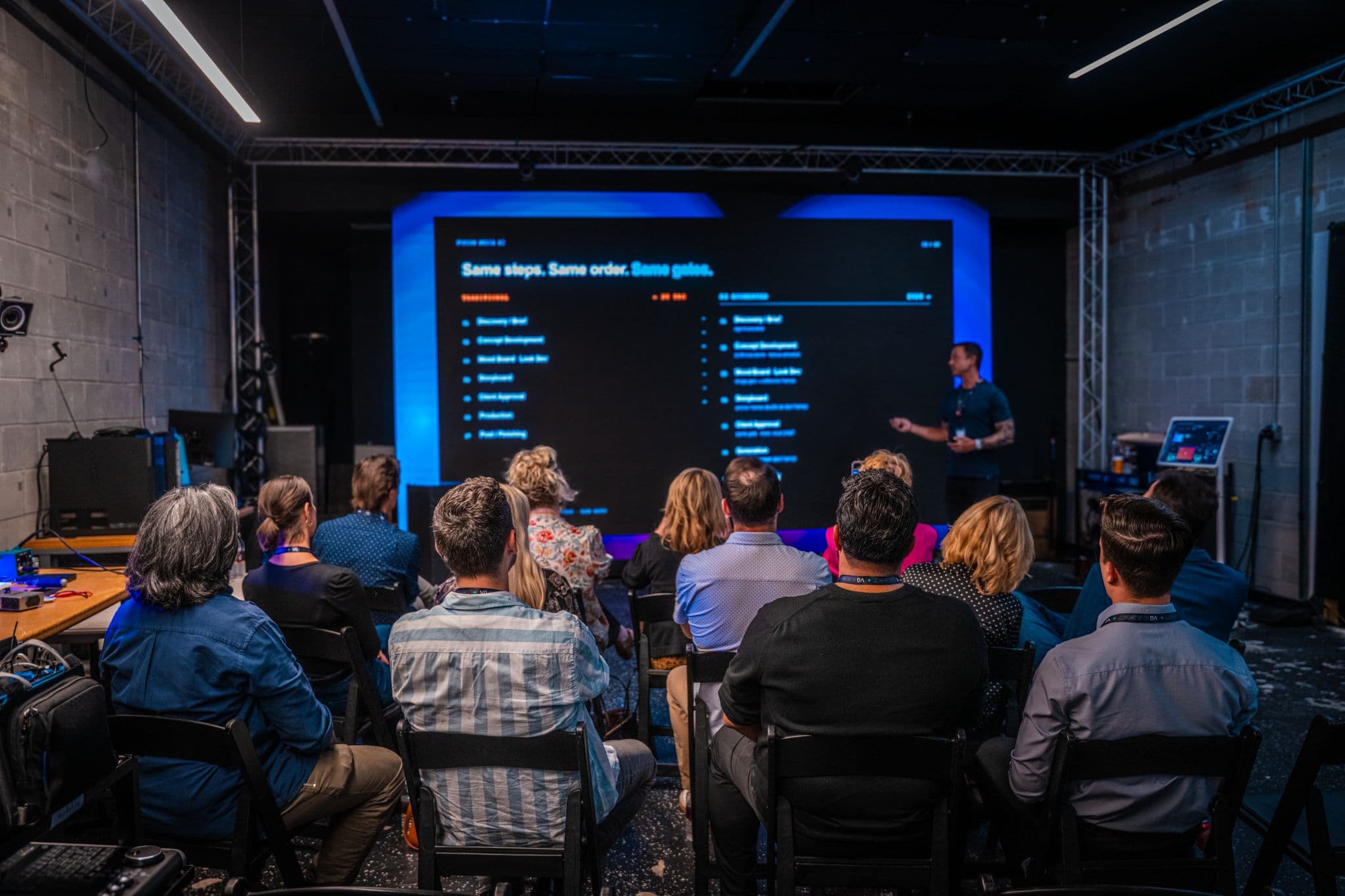
AI integration in video production starts in pre-production, not with a video generation model. The fastest, lowest-risk way to adopt AI is to deploy specialized AI agents against your existing pre-production workflow: creative briefs, scripts, storyboards, and shot planning. The workflow doesn't change. The toolkit does.
That was the thesis of the breakout session Fusion Media AI CEO Corey Holtgard taught last week at a Tampa AI summit, now in its second year, delivered four times across rotating audiences of brand, agency, and production teams. This post recaps the full framework. The complete slide deck is free here: AI in Pre-Production, the 2026 summit deck.
Why Does AI Adoption Start in Pre-Production?
Because pre-production is where every video succeeds or fails, and it's where AI does the most useful work with the least risk.
Most teams approach AI backwards. They open a video generator, type a prompt, get a mediocre clip, and conclude AI "isn’t ready." But generative video is the *last* step of a production pipeline, not the first. A model can only execute what pre-production defines: the concept, the audience, the script, the visual language, the shot list.
After 20+ years producing broadcast television and national commercials, the discipline Corey brought into the AI era is the same one that governed every traditional production: nothing gets generated until the brief, script, and boards are locked. AI doesn't eliminate that process. It compresses it from weeks to days.
What Is the Human + AI + Human Workflow?
Human + AI + Human is a production model where human creativity directs strategy in pre-production, AI accelerates execution in production, and human editors deliver final emotional polish in post.
It is the operating model behind every Fusion Media AI project, and it solves the two biggest failures of fully automated AI video: the uncanny valley and the absence of intent. AI is a force multiplier inside a human-led process, never a replacement for the people who know what a story needs.
In pre-production specifically, that means humans own the creative judgment (what the story is, who it's for, why it matters) while AI agents handle the high-volume drafting work underneath it.
How Do You Build an AI Pre-Production Team?
You build it as a small team of specialized AI agents (each with one job, custom instructions, and its own knowledge base) rather than one general-purpose chatbot. The core stack presented at the summit:
- A Creative Director agent. Search-enabled and research-equipped. It studies the client, market, and audience, and produces the creative brief: the document everything downstream depends on.
- A Commercial Script Architect. A writing specialist trained on commercial structure, pacing, and brand voice. It turns the brief into scripts built for the format and runtime.
- An Image & Video Prompt Specialist. A technical translator that converts approved scripts into precise, model-ready prompts for anchor frames and motion: the role our Higgsfield Director agent plays inside the FMAI pipeline.
Two build principles make this work:
- Write custom instructions and knowledge bases in Markdown. Plain, structured Markdown files are the most reliable way to give an agent durable expertise (brand guidelines, format specs, past briefs) without bloating every prompt.
- Storyboard with a template, not from scratch. Feeding a locked creative brief and generated frames into a pre-built storyboard template (we use Claude Design) renders detailed, client-ready boards in minutes.
Should You Build Agents or Use an Orchestrated Platform?
Both paths are valid. The right one depends on how your team works.
Path A: Build your own agent team. Maximum control, deep customization to your brand and process, and compounding value as each agent's knowledge base grows. The tradeoff is setup time and maintenance.
Path B: Run an orchestrated platform. Tools like Higgsfield's Supercomputer route a single request across multiple models and handle the coordination for you. Faster to start, less control over the in-between steps.
The honest answer from the stage: FMAI uses both. The agent team owns pre-production; orchestrated tooling accelerates generation. Pick the path that matches your team's appetite for building.
What Are the Biggest Mistakes When Adopting AI in Production?
The session closed on the traps that cost teams real money:
- Starting with the toolkit instead of the workflow. Map your existing process first; insert AI where the bottlenecks are.
- Building everything at once. Corey's own pipeline now runs eleven agents, but it started with one. The Script Architect alone returned roughly four hours a week. Build one agent, run it for two weeks, then build the next.
- Pitching the impossible. Never promise a client something the technology can't reliably deliver yet. Over-promising on AI capability will cost you the relationship, and the rework will eat the margin.
- Skipping the human pass. AI output is a draft, not a deliverable. The final judgment is always human.
About the Summit
The 2026 summit, its second, brought together brands, teams, and organizations in Tampa for live demos and hands-on sessions on AI, real-time production, and next-generation creative tools. Speakers included Corey Holtgard (Fusion Media AI), Kevin De Lucia, Kristy Reed, and Jamie Clemens. A digital white paper from the event is available here (opens in a new tab).
Corey HoltgardFounder & CEO, Fusion Media AI