Strategy · Services program
How Tampa Businesses Are Using AI Video to Dominate Search in 2026
AI engines can't watch videos. They read structured text. How Tampa businesses use SearchGPT Deployment Kits to force citation by SearchGPT, Perplexity, and Google AI Overviews.

Tampa businesses dominate AI search in 2026 by making their video content readable to large language models. AI engines like SearchGPT, Perplexity, and Google AI Overviews cannot watch video. They can only read text, structured data, and schema markup. Brands that ship a SearchGPT Deployment Kit alongside every video become the source AI engines cite. Brands that don't, become invisible.
The traffic-distribution model that funded digital marketing for thirty years is collapsing, and the data confirming it is no longer correlational. Eighty-three percent of queries that trigger Google AI Overviews now end without a single click, and Google AI Mode, which replaces traditional results entirely with a Gemini-synthesized answer, reached 100 million monthly active users in Q1 2026 with a 93 percent zero-click rate. The first causal evidence landed in April 2026: a randomized field experiment by researchers at the Indian School of Business and Carnegie Mellon found that when AI Overviews appear, organic clicks drop 38 percent and zero-click search rises from 54 percent to 72 percent. This is no longer a trend. It is the architecture. For Tampa Bay brands, the implication is sharp: if your content is not engineered for AI citation, your brand is functionally absent from the most important moments in the buyer's journey.
This post is for Tampa business owners, CMOs, and agency leads who already understand the Zero-Click crisis (if you don't, start with our AEO primer) and want to understand the specific mechanism that converts video content into AI citations. It explains what a SearchGPT Deployment Kit is, why it works, why no other Tampa AI video studio offers one, and what "winning" actually looks like when AI engines start citing your brand.
If you haven't read the cluster cornerstone yet, the 2026 Tampa Buyer's Guide sets the broader context.
What is the Zero-Click crisis, and why does it matter to Tampa businesses?
The Zero-Click crisis is the structural collapse of the click-based traffic model. AI search engines now resolve most informational queries inside the search interface itself, leaving buyers with an answer and no reason to visit a website. The cost of this shift is uneven: it falls hardest on brands whose authority lives only inside their website and whose video content lives only on platforms LLMs cannot index.
The impact is also unevenly distributed by vertical, which matters for Tampa Bay specifically. Per SE Ranking's 2025 niche analysis (cross-validated against Ahrefs November 2025 data), AI Overview trigger rates vary sharply by category:
| Vertical | AI Overview Trigger Rate |
|---|---|
| Healthcare | 43 to 63 percent |
| Science and research | 43.6 percent |
| Business and B2B services | 38.84 percent |
| Technology | 33.67 percent |
| Real estate | 5.8 percent |
| E-commerce / shopping | 3.2 percent |
For Tampa medical and dental practices, law firms, financial advisors, and B2B services brands (the categories that dominate the Tampa Bay business community), AI Overviews are triggering on roughly one in three to two in three of every informational query their buyers run. Local service businesses lose the high-intent "near me" queries to AI-resolved local packs. Regional retail and DTC brands lose discovery traffic to AI-generated comparison answers. And agencies pitching Tampa accounts lose competitive bake-offs to firms whose case studies and POVs are already being cited by the AI tools their prospects use during vendor research.
The Tampa businesses winning right now are the ones reframing the question. Not *how do we rank?* but *how do we become the source the AI cites?*
Why can't AI engines watch your videos?
Large language models are text-native. They read tokens: words, characters, structured markup. They do not have eyes. When a buyer asks SearchGPT "What does studio-grade AI video production cost in Tampa?", the model is not browsing YouTube and watching commercials. It is reading whatever text-based information has been published about that question and synthesizing an answer from the highest-authority sources.
This means a beautifully produced 60-second commercial sitting on YouTube, even one with strong view count and engagement, is essentially invisible to the AI citation graph if it ships without a text-native companion. The LLM has no way to know the video exists, what question it answers, who made it, or whether it should be cited.
What LLMs *can* read:
- JSON-LD structured data embedded on the video's host page: Article, VideoObject, FAQPage, and Organization schema.
- Semantic transcripts formatted as crawlable text, ideally with timestamp anchors and speaker attribution.
- Answer-first companion articles structured around the same questions the video addresses.
- Author entity markup establishing the human source as a recognized Person entity in the knowledge graph.
A video without those four signals is, for AI search purposes, a file in a folder. A video shipped with all four becomes a citable source.
What is a SearchGPT Deployment Kit?
A SearchGPT Deployment Kit is the proprietary deliverable Fusion Media AI bundles with every video produced under our retainer model. It is the text-native infrastructure that converts a finished video into a machine-readable, citable asset that AI engines treat as an authoritative source on the topic.
Every Kit contains four components:
| Component | Purpose |
|---|---|
| JSON-LD schema package | Article, VideoObject, FAQPage, and Person schema, validated against the Google Rich Results Test. Makes the video and its metadata machine-readable to every major AI engine. |
| Semantic transcript layer | Full video transcript formatted for LLM ingestion: speaker-attributed, paragraph-broken, timestamped, with the question being answered surfaced explicitly. Indexable as crawlable text. |
| Answer-first companion article | A 1,500 to 2,500 word piece structured around the semantic cluster the video addresses: Direct Answer in the first 60 words, question-based H2 headings, comparison tables, FAQ block. Built to be extracted as a snippet by any AI engine. |
| Citation Loop syndication plan | A 21-day syndication sequence routing the canonical URL through LinkedIn (native post plus Article), the FMAI X channel, and the FMAI Google Business Profile post stream. Each touch creates an independent external citation node pointing back to the canonical URL. |
Retainer clients receive SearchGPT Deployment Kits as scoped to their program.
How does a SearchGPT Deployment Kit force AI citation?
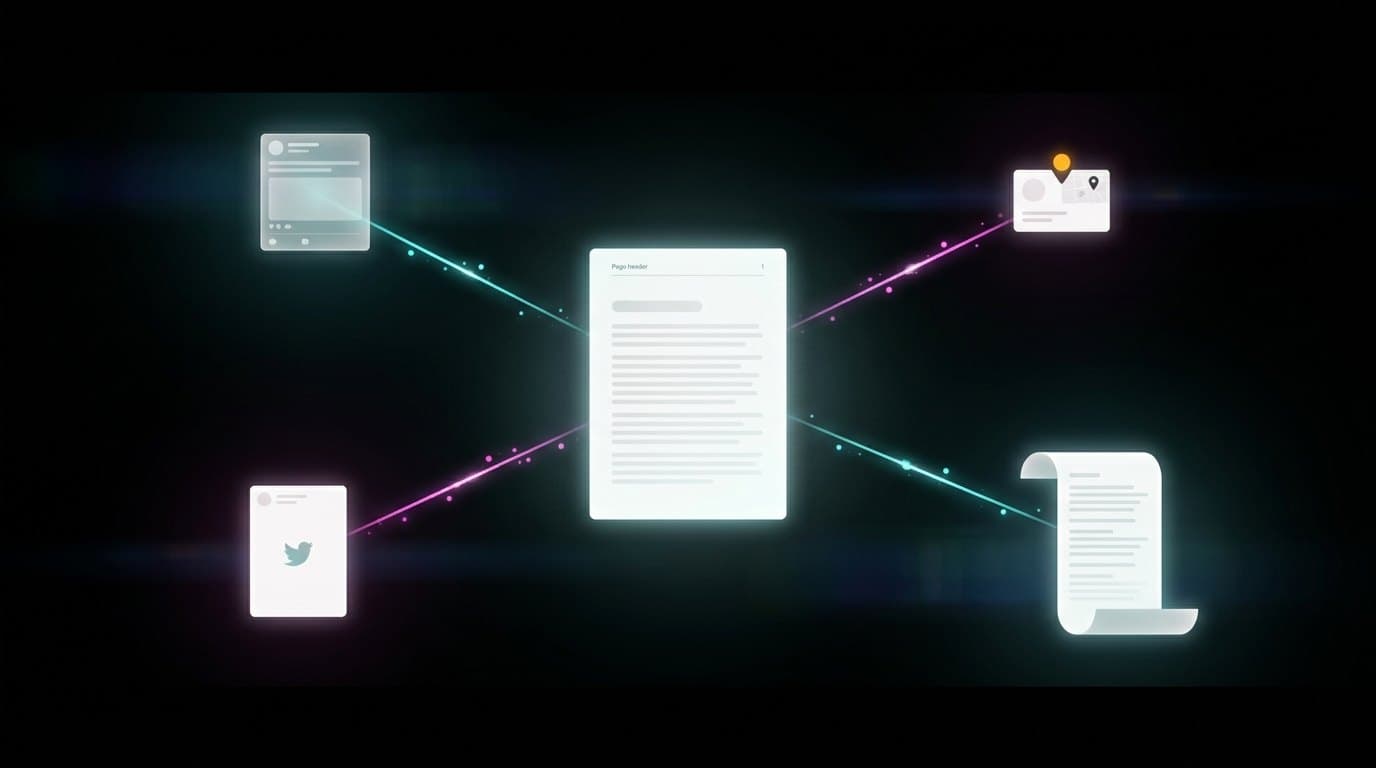
The mechanism works because AI engines triangulate authority across multiple independent signals before they decide which source to cite. A single optimized page is not enough. The Kit is built to produce four independent signals from a single video asset:
Signal 1: On-page schema authority. The canonical blog post on fusionmedia.ai carries Article schema with Corey Holtgard named as a Person entity, datePublished, dateModified, and a verified Organization publisher. VideoObject schema embeds the video as a first-class resource. FAQPage schema marks the question-answer pairs explicitly. AI engines crawl all of it.
Signal 2: Semantic transcript indexability. The full transcript publishes as crawlable text on the same canonical page. When an AI engine answers a query that maps to anything said in the video, the transcript text is what gets matched and excerpted.
Signal 3: External authority corroboration via LinkedIn. Two days after the canonical post goes live, the same point of view publishes as a native LinkedIn post from the author's personal channel (Corey Holtgard, CEO, 20-plus years broadcast, 900-plus national series). Five days after that, a shortened version publishes as a LinkedIn Article, independently indexed by Google and AI search engines. Both touchpoints route back to the canonical URL.
Signal 4: Off-domain GBP and X corroboration. The Google Business Profile post stream and the FMAI X channel both link to the canonical URL within the syndication window, adding two more independently indexed nodes to the citation graph.
By the end of the 21-day Citation Loop, an AI engine answering a target query sees one canonical URL pointing to one answer, corroborated by four independent high-authority external nodes, all authored or published by the same recognized Person and Organization entity. That is the structural pattern AI engines treat as citation-worthy.
Why don't other Tampa AI video studios offer this?
Most Tampa video shops are still operating on the old model: selling video as a craft deliverable, finished and handed off as an MP4. The work itself may be excellent. The asset that ships is a beautiful, invisible orphan from the perspective of AI search.
Building SearchGPT Deployment Kits at production scale requires four capabilities most video studios do not have under one roof:
| Capability | Why It Matters | Where Tampa Competitors Typically Fall Short |
|---|---|---|
| AEO methodology and schema engineering | The Kit's value depends on technically valid, complete JSON-LD markup. | Most video shops do not employ SEO or schema specialists. |
| Long-form editorial production | The companion article must be authored at AEO-grade, not blog-filler quality. | Video studios typically do not staff senior writers. |
| Author entity and personal brand infrastructure | The Person entity must be a recognized authority across multiple platforms. | Solo producers and small shops lack the cross-platform authority footprint. |
| Multi-channel syndication operations | The 21-day Citation Loop requires coordinated publishing across at least four platforms. | Most studios stop at "we delivered the video." |
Fusion Media AI built the Kit because we operate as a Tech-Enabled Creative-as-a-Service platform, not a traditional video shop. The same agentic AI pipeline that produces the video (The Fusion Core) also drafts the schema, generates the semantic transcript, and stages the syndication plan. The Kit is not an add-on. It is a structural output of the way the studio is engineered.
This is what we mean when we say AEO is FMAI's structural moat in the Tampa market. It is a deliverable category no other local studio is currently positioned to produce at retainer scale.
What does "Share of Answer" look like for Tampa brands?
Share of Answer is the AI-era replacement for Share of Voice. It measures the percentage of target-query AI responses that cite your brand as a source.
The measurement protocol Fusion Media AI uses with retainer clients:
- Define the target query set: typically 10 to 25 commercial-intent questions a buyer would ask an AI engine during the relevant stage of the consideration cycle.
- Run the queries monthly across SearchGPT, Perplexity, Google AI Overviews, and Claude with browsing enabled.
- Log citation events: every instance where the brand is referenced by name, by URL, or via attributed content.
- Track the trajectory: Share of Answer typically climbs from near zero to dominant citation across three to six months of consistent SearchGPT Deployment Kit production.
For a Tampa Bay personal injury law firm, that target set might include "best Tampa personal injury attorney for truck accidents," "average truck accident settlement in Hillsborough County," and "what does a personal injury contingency fee cover in Florida." For a Tampa retail brand, it might be product-comparison queries against named regional competitors.
The compounding effect matters. Each cited answer increases the probability of future citation on adjacent queries, because AI engines weight recently-cited sources more heavily in subsequent retrievals. Once a Tampa brand becomes the default-cited authority on its core query set, that position is durable, and increasingly expensive to displace.
How should a Tampa business start?
The execution sequence we recommend, in order:
- Audit existing video assets for the four AEO signals: schema, transcript, companion article, syndication. Most Tampa brands score zero out of four on their current YouTube library.
- Map the 10 to 25 target queries where citation matters. These are the questions your highest-intent buyers ask an AI engine when researching your category.
- Engage an AEO-equipped studio. Either build the capability in-house at a fixed-cost team of three to five specialists, or retain a productized Tampa AI video production studio with SearchGPT Deployment Kits bundled into the engagement.
- Commit to a 21-day Citation Loop on every published asset. A great video without the Loop is a great asset with no citation lift.
- Measure Share of Answer monthly. Track the trajectory, not the absolute number, for the first 90 days.
The Tampa Bay brands that move on this in the next two quarters will own the AI citation graph in their categories through 2027. The ones that wait will be writing competitive-displacement plans by Q2 of next year.
Corey HoltgardCo-Founder & CEO, Fusion Media AI