
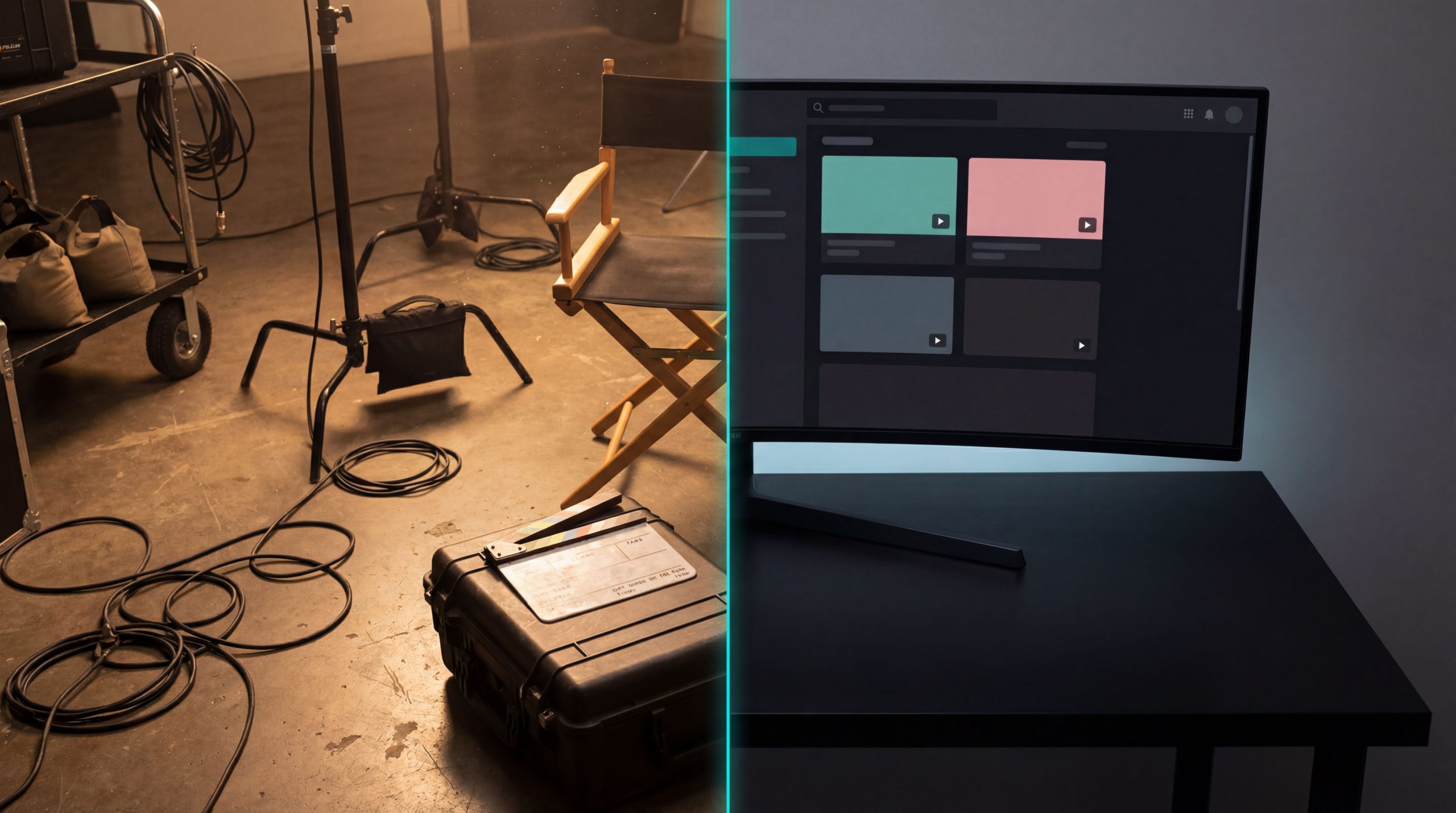
CapEx vs OpEx: Why Enterprise Video Production Is Moving to Retainers in 2026
By Corey Holtgard | Fusion Media AI | April 2026
Enterprise video production is abandoning the one and done project model. In 2026, CMOs, CLOs, and franchise operators are shifting video spend from volatile Capital Expenditures (CapEx), single shoots with unpredictable costs and rapidly decaying assets, to predictable Operating Expenditures (OpEx) through monthly retainers that treat video like software: always on, always updated, and always compounding in value.
The enterprise video market is projected to reach nearly $29 billion in 2026 and grow to over $46 billion by 2031. But the spending model driving that growth has fundamentally changed. Companies are no longer writing six figure checks for one time productions that sit on a shelf. They are subscribing to video the same way they subscribe to Salesforce or HubSpot, as a living operational tool that ships content on a cadence, adapts to market shifts in days, and compounds Search Engine authority over time.
This is the Video as Software model. And if you’re still budgeting video as a project, you’re building on a foundation that the market has already moved past.
What Is the Difference Between CapEx and OpEx in Video Production?
CapEx (Capital Expenditure) in video production means a large, one time investment in a single shoot or campaign, typically $25,000 to $150,000+ for enterprise grade content, that produces a fixed set of deliverables with no built in mechanism for updates, iteration, or ongoing content velocity. OpEx (Operating Expenditure) means a predictable monthly retainer that continuously delivers video assets, AI search optimization, and content refreshes as an ongoing operational cost.
The distinction matters because it changes how CFOs evaluate video. A CapEx video project hits the balance sheet as a depreciating asset. The ROI window is short. The content is static. When the market shifts, a competitor launches, a regulation changes, a product updates, the asset is already stale.
An OpEx retainer hits the income statement as a deductible operating cost. The budget is predictable. The content is living. When the market shifts, the retainer adapts within the current billing cycle.
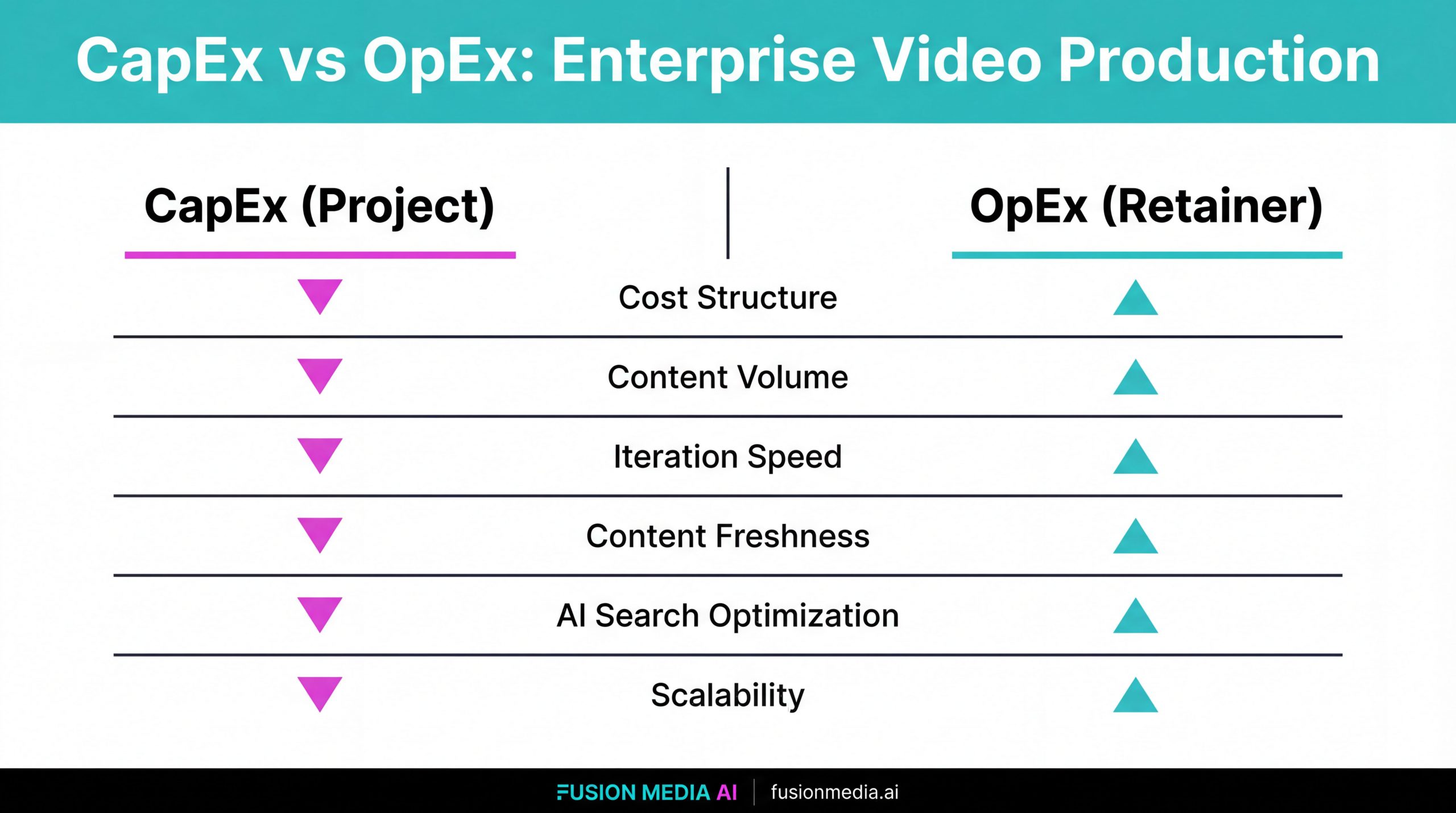
Here’s how the two models compare across the dimensions that enterprise buyers actually evaluate:
| Factor | CapEx (Project Based) | OpEx (Retainer Based) |
|---|---|---|
| Cost Structure | $25K to $150K+ one time spend | $5K to $20K/month predictable spend |
| Budget Approval | Requires capital budget approval, often quarterly | Falls under operational budget, monthly approval |
| Content Volume | Fixed deliverable set (3 to 5 assets typical) | Continuous output (4 to 12+ assets/month) |
| Time to First Asset | 6 to 12 weeks (pre production through post) | 2 to 4 weeks (onboarding), then rolling delivery |
| Iteration Speed | New project = new budget cycle | A/B variants ship within the retainer |
| Content Freshness | Static, decays immediately after launch | Living, updated monthly, freshness signals maintained |
| AI Search Optimization | Rarely included | SearchGPT Deployment Kits included as standard |
| Tax Treatment | Capitalized, depreciated over 3 to 5 years | Fully deductible in the year incurred |
| Scalability | Linear: more content = more projects = more cost | Compounding: retainer infrastructure scales output without proportional cost increase |
The global CapEx to OpEx shift is not unique to video. Worldwide IT spending is projected to reach $6.15 trillion in 2026, with software growing 14.7% and cloud infrastructure growing 31.7%, nearly all of it classified as OpEx. Video production is following the exact same trajectory that cloud computing, SaaS, and managed IT services followed over the past decade.
Why Is Traditional Video Production Broken for Enterprise in 2026?
Traditional project based video production fails enterprise buyers in 2026 because it cannot match the velocity demands of AI search engines, social platforms, and global L&D operations, all of which require continuous, fresh content delivered in weeks, not quarters.
The math is straightforward. A traditional enterprise video shoot involves:
- 4 to 6 weeks of pre production (scripting, casting, location scouting, scheduling)
- 1 to 3 days of physical production (crew, talent, equipment, travel)
- 4 to 8 weeks of post production (editing, revisions, color, audio mix, legal review)
- Total timeline: 10 to 16 weeks from kickoff to final delivery
In that same 16 week window, an AI powered retainer model, like the Human + AI + Human pipeline that Fusion Media AI operates through The Fusion Core, delivers 16 to 48 finished video assets, plus social cutdowns, plus AI search optimization articles, plus multilingual dubbing.
The velocity gap is not a marginal difference. It is a structural mismatch between how enterprise content is produced and how enterprise content is consumed.
Three forces are accelerating this mismatch:
- AI Search Engines Penalize Stale Content. Google AI Overviews, Perplexity, and SearchGPT all weight content freshness as a citation signal. A video produced once and never updated loses AI visibility within months. This is what we call Content Decay, the silent erosion of an asset’s value when it stops being refreshed.
- Platform Algorithms Reward Velocity. Meta, TikTok, YouTube, and LinkedIn all algorithmically reward accounts that publish consistently. A single campaign burst followed by months of silence actively damages algorithmic reach.
- Global Workforces Demand Continuous Training. For enterprise L&D and franchise operations, a one time training video production is obsolete the moment a menu changes, a safety protocol updates, or a new compliance regulation takes effect. Deskless workers in QSR and retail need updated content pushed to their phones in 48 hours, not 16 weeks.
What Does “Video as Software” Actually Mean?
“Video as Software” means treating video content as a continuously deployed, version controlled operational tool, not a one time creative project. Like SaaS, the asset is never “finished.” It ships, iterates, updates, and compounds value on a predictable cadence tied to a monthly or annual subscription.
The analogy is precise, not metaphorical:
- SaaS ships updates monthly. A video retainer ships new assets monthly.
- SaaS patches bugs and security issues. A video retainer updates compliance language, pricing changes, and product updates.
- SaaS scales users without rebuilding the platform. A video retainer scales content volume without rebuilding the production pipeline because the pipeline (the AI generation engine, the voice clones, the style templates) is already built and reusable.
- SaaS is expensed as OpEx. A video retainer is expensed as OpEx.
In our experience operating The Fusion Core, Fusion Media AI’s proprietary agentic AI pipeline, the “Video as Software” model delivers a specific, measurable advantage: we store engine metadata for every render, enabling flawless 1:1 reproducibility months later. That means a training video produced in January can be updated with new compliance language in June using the exact same visual style, voice, and branding without starting from scratch.
This is the operational moat that project based production cannot replicate. Every project starts from zero. Every retainer builds on what came before.
How Much Does a Video Production Retainer Cost Compared to Project Based Pricing?
A typical enterprise video retainer ranges from $5,000 to $20,000 per month and delivers 4 to 12+ finished assets per month, plus AI search optimization, social cutdowns, and multilingual support. A comparable volume of project based work would cost $50,000 to $150,000+ per quarter with significantly longer turnaround times.
Here is a direct pricing comparison using Fusion Media AI’s 2026 rate card as a benchmark:
| Model | Annual Spend | Annual Video Output | Cost Per Finished Asset | Includes AI Search (AEO)? |
|---|---|---|---|---|
| CapEx: 4 Quarterly Projects | $100,000 to $200,000 | 12 to 20 videos | $5,000 to $16,000 | Rarely |
| OpEx: Tier 1 Retainer ($10K/mo) | $120,000 | 48 videos + 48 social cuts + 24 SearchGPT Kits | ~$1,250 per video (blended) | Yes, 2 Kits/month included |
| OpEx: Tier 2 Retainer ($20K/mo) | $240,000 | 144 videos + 144 social cuts + 48 SearchGPT Kits | ~$715 per video (blended) | Yes, 4 Kits/month included |
The unit economics tell the story. At Tier 2 retainer volume, the blended cost per finished video asset drops below $715, a fraction of what a traditional production house charges for a single 30 second spot. And that per unit cost includes SearchGPT Deployment Kits, the structured content packages that force AI search engines to cite your brand as the definitive industry answer.
For enterprise L&D buyers specifically, the Living Content Retainer model (priced at 20% to 30% of the initial build annually) ensures that Neural Assets, executive Digital Twins and training modules, stay current without triggering a new capital budget request every time a regulation changes.
What Is Content Decay and How Do Retainers Solve It?
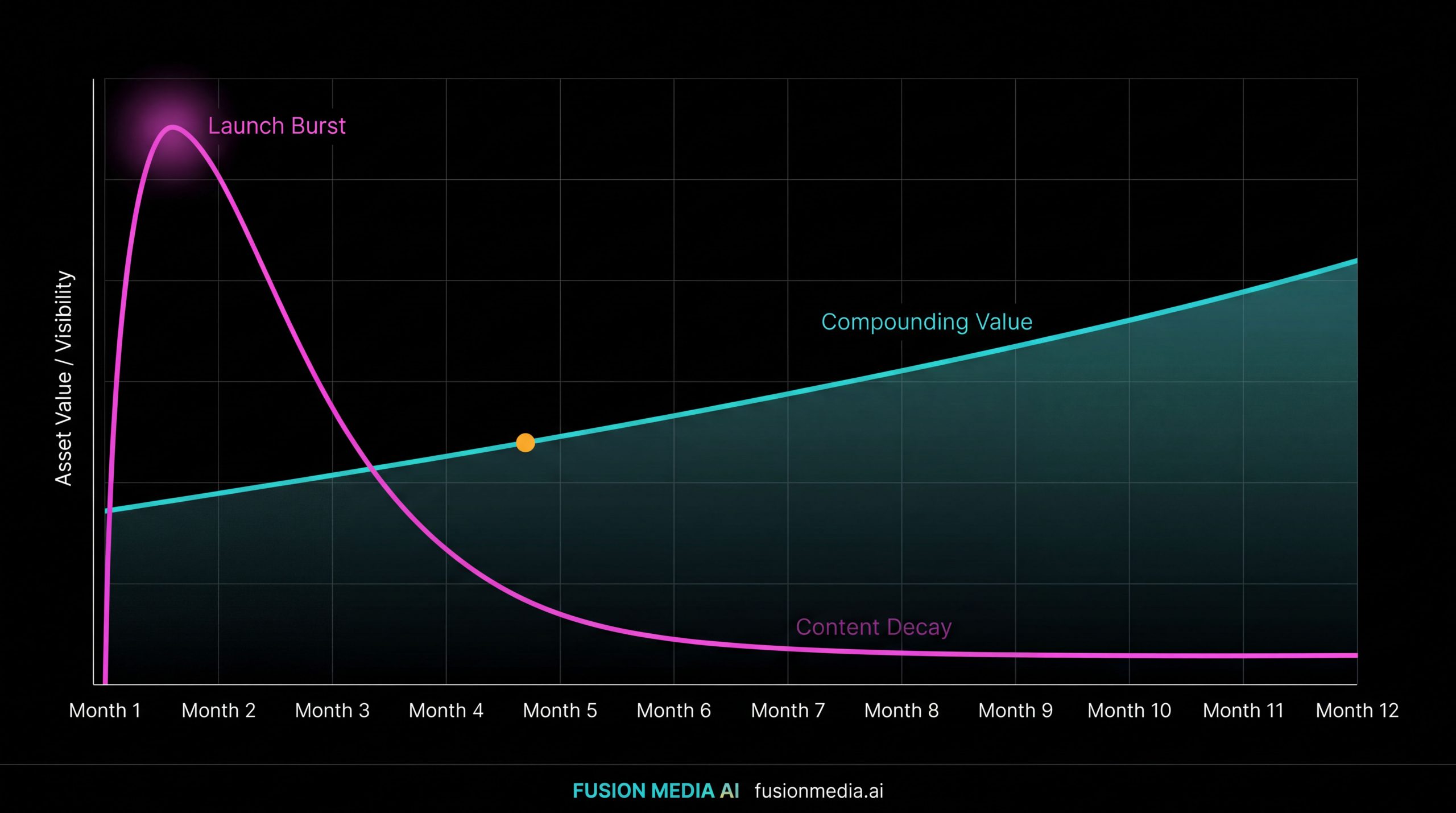
Content Decay is the measurable loss of an asset’s search visibility, engagement rate, and operational relevance over time when that asset is not updated, refreshed, or republished. In video production, Content Decay is the silent killer of CapEx ROI. A $50,000 brand anthem loses the majority of its distribution value within 6 months if it is not supported by fresh content.
Content Decay is not a theory. It is observable in three data streams:
- Search Visibility Decay: Google AI Overviews and Perplexity deprioritize content that hasn’t been updated. A blog post or video page with a
dateModifiedsignal older than 90 days gets outranked by fresher competitors. - Social Algorithm Decay: Platform algorithms measure recency and velocity. An account that published a burst of content 6 months ago and went silent sees organic reach collapse.
- Operational Decay (L&D): A training video produced under a previous compliance framework becomes a liability, not an asset, the moment regulations change. For industries subject to BIPA, HIPAA, or California AB 2602, outdated training content is a legal exposure.
The retainer model solves Content Decay structurally:
- Monthly publishing cadence maintains freshness signals for AI search engines
- Rolling A/B testing replaces underperforming assets before they decay
- Automated updates to Digital Twin training modules keep compliance content current within the existing retainer scope
- SearchGPT Deployment Kits extend the discoverability window of every video asset by pairing it with structured, schema optimized companion content
How Should a CFO Evaluate Video Production: CapEx or OpEx?
A CFO should evaluate video production as OpEx when the business requires continuous content output, predictable monthly costs, immediate tax deductibility, and the flexibility to scale spend up or down based on business conditions, which describes the majority of enterprise video use cases in 2026.
The CFO’s decision framework comes down to four questions:
- Is this a one time need or an ongoing operational requirement? If the business will need new video content every month for marketing, training, compliance, or AI search, it is an operational expense, not a capital investment.
- Do we need budget predictability or can we absorb large irregular expenses? Retainers deliver fixed monthly costs. Projects deliver unpredictable invoices that spike during production quarters and go to zero between them.
- How important is immediate tax deduction? OpEx is fully deductible in the year incurred. CapEx is capitalized and depreciated over 3 to 5 years. For companies managing tight annual budgets, the immediate OpEx deduction is significantly more favorable.
- What is the cost of content going stale? If a competitor publishes fresh AI optimized content while your last video is six months old, the revenue impact of Content Decay exceeds the cost of the retainer.
In our experience working with CMOs and CLOs across the enterprise, retail, and franchise verticals, the companies that switch from project based to retainer based video production report three consistent outcomes: lower per unit content costs, faster time to market, and sustained AI search visibility that project based competitors cannot match.
Frequently Asked Questions
Is a video production retainer more expensive than project based work?
On a per asset basis, retainers are significantly less expensive. A Tier 1 retainer at $10,000/month delivers 48 videos annually at approximately $1,250 per asset, compared to $5,000 to $16,000 per asset in a traditional project model. The retainer also includes AI search optimization and social cutdowns that project based pricing typically excludes.
Can I switch from a CapEx video budget to an OpEx retainer mid year?
Yes. Most enterprise accounting departments can reclassify video spend from capital to operating budgets within a single budget cycle. The key is presenting the retainer as an operational subscription, similar to SaaS, rather than a creative services contract.
What happens to my existing video assets when I start a retainer?
Existing assets remain yours. A retainer builds on top of your current library by producing new content, refreshing outdated pieces, and pairing legacy videos with SearchGPT Deployment Kits to extend their AI search visibility.
Does the retainer model work for regulated industries (healthcare, legal, financial services)?
Yes. Retainers are particularly valuable for regulated industries because compliance requirements change frequently. A Living Content Retainer ensures training modules, Digital Twin assets, and compliance videos are updated within the existing monthly scope without triggering a new capital budget approval for every regulatory change.
How does AI video production maintain quality at retainer volume?
At Fusion Media AI, every asset passes through a Human + AI + Human pipeline. Human strategists script and direct. The Fusion Core (our proprietary agentic AI pipeline) generates at scale. Human editors with 25+ years of broadcast experience, Emmy and Clio level, polish every frame. Quality is never traded for velocity.
