

Why Your Franchise Training Binder Is Costing You $1.17M/Year
There is a 3-ring binder sitting in the back office of one of your franchise locations right now.
Nobody has opened it in four months.
It is 187 pages long, written at a 12th-grade reading level, and printed in English for a crew where 40% of your frontline workers speak Spanish or Tagalog as their first language.
That binder is not a training tool. It is a liability dressed up as compliance.
Here is the math most franchise operators refuse to confront.
The $1.17M Problem You Already Know About (But Haven’t Solved)
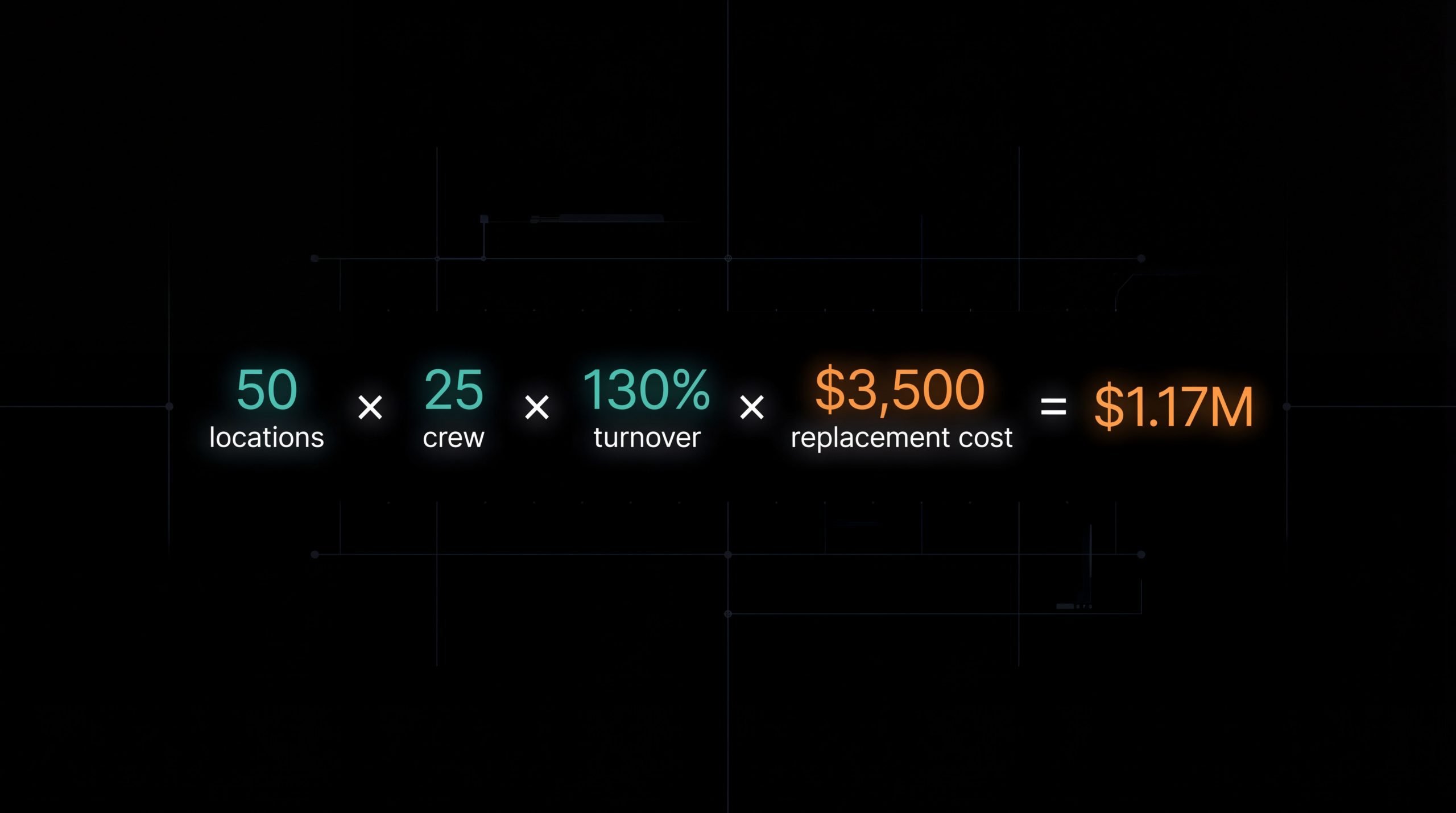
The average franchise network runs 100% to 130% annual frontline turnover depending on the vertical. QSR and hospitality sit at the top of that range. Retail, fitness, and home services are not far behind.
SHRM pegs the average cost to replace a single hourly worker between $3,500 and $5,000 when you factor in recruiting, onboarding, training time, and the productivity gap while a new hire gets up to speed.
Run that across a 50-unit franchise network with an average of 25 crew members per location, turning over at 130%, and you land at a conservative $1.17M per year burned on a revolving door.
The binder did not cause turnover. But it absolutely failed to prevent it.
When your training content is inaccessible, irrelevant to a mobile-first workforce, and impossible to update faster than your business moves, you are not training. You are checking a box. And that box is expensive.
Why the Binder Model Is Structurally Broken
This is not a willpower problem. It is an infrastructure problem.
Traditional franchise training was built for a world where crew members stayed for two years, spoke the same language, and had time to sit in a back office reading laminated pages before their shift.
That world is gone.
Today’s deskless workforce is Gen Z, multilingual, phone-native, and making a stay-or-leave decision within the first 72 hours. They are not going to read your binder. They are going to watch a 45-second video on their phone between tasks — or they are going to quit and walk to the competitor down the street that made onboarding feel less like a DMV appointment.
The velocity problem compounds when your business changes faster than your training can keep up. A new seasonal promotion hits, a safety protocol gets updated, corporate rolls out a revised service procedure, and your ops team spends two weeks manually distributing updated materials across dozens of locations. By the time the floor team is trained, the window is half over.
Whether you are rolling out a limited time menu item in a QSR kitchen, a new product display planogram in retail, an updated equipment protocol at a fitness franchise, or a revised service checklist for a home services brand, the bottleneck is identical. The content pipeline cannot move at the speed the business demands.
You cannot solve an algorithmic velocity problem with a six-week physical production schedule.

The Shift: Video as Software
The fix is not “make better binders.” The fix is rearchitecting how training content gets created, localized, and delivered — permanently.
At Fusion Media AI, we treat training content the way a software company treats code. It ships fast, it updates instantly, and it scales without adding headcount.
Here is what that looks like in practice.
A franchise operator sends us one page from their legacy SOP manual. Within 48 hours, we return a studio-grade, 9:16 vertical microlearning module — dubbed in Spanish, Tagalog, or Mandarin — built for the way deskless workers actually consume information: on their phones, on the floor, in under 60 seconds.
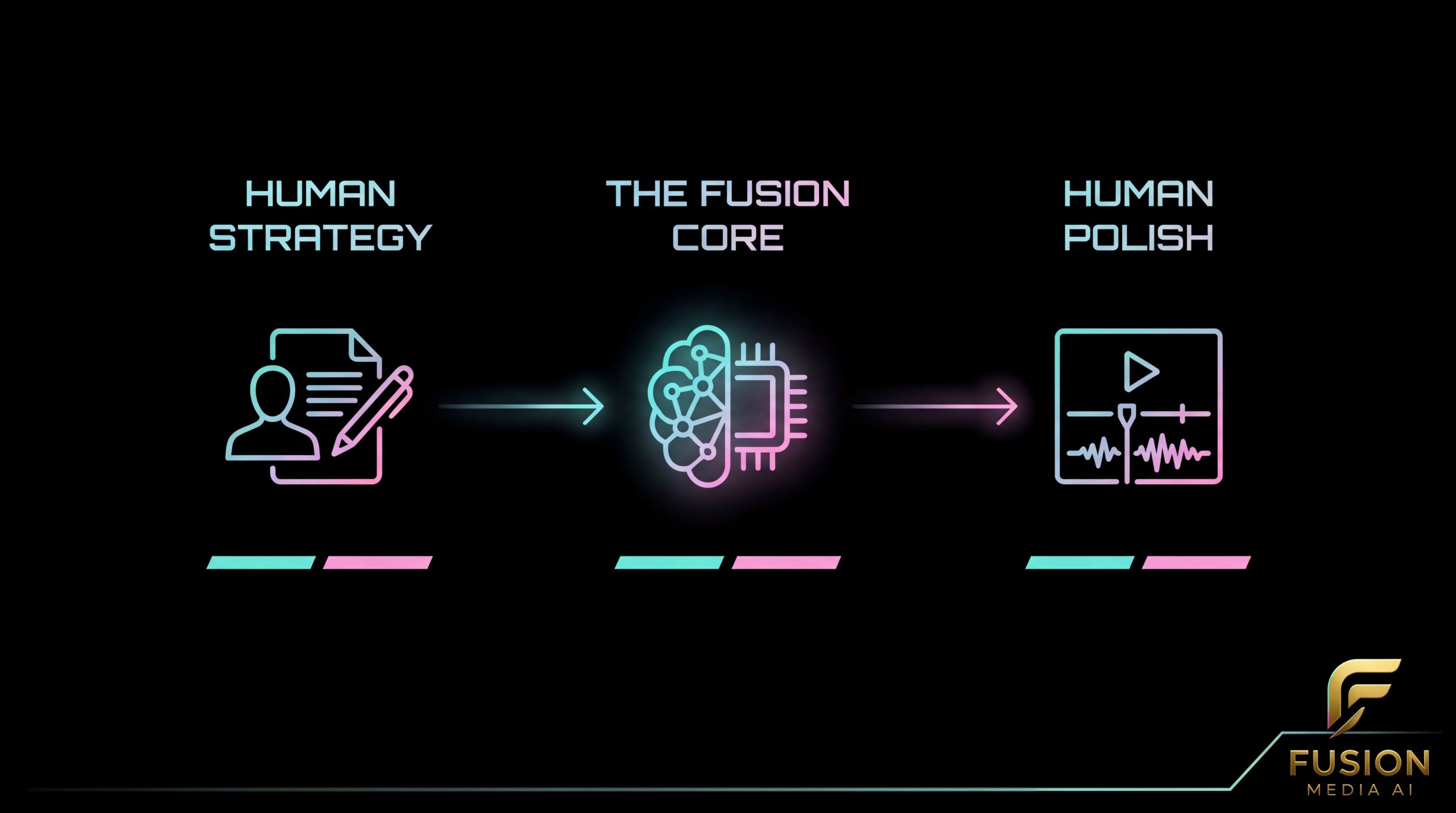
We do not run this through a text-to-video generator and call it done. Our production model is Human + AI + Human. Instructional designers rewrite the content for the ear. Our proprietary pipeline — The Fusion Core — renders the visual assets at scale. Then broadcast-level editors polish every frame to eliminate the synthetic artifacts that make frontline teams distrust AI-generated content.
The result is not a glorified PowerPoint with a voiceover. It is cinema quality at digital speed, pushed directly to the frontline via deep-linked QR codes at workstations and integrated into mobile-first LXPs like Axonify or Schoox.
When something changes in the business, we turn the updated training around in 48 hours. Not two weeks. Not after the rollout window closes.
The ROI That Franchise CFOs Actually Care About
Reducing turnover by even 15–20% at a 50-unit network puts six figures back on the P&L every year, compounding.
But the real shift is moving training spend from CapEx to OpEx. Instead of sinking budget into a one-time binder print run that is outdated the moment your business evolves, franchise operators lock in a predictable monthly retainer that keeps every location current, compliant, and speaking the same language — literally.
That is not a training expense. That is operational infrastructure.
The Binder Era Is Over
The franchise operators who are scaling right now have already made this shift. They stopped treating training as a document problem and started treating it as a content velocity problem.
The ones still relying on 3-ring binders and translated PDFs are bleeding $1.17M a year and wondering why their retention numbers never move.
Evolution vs. Dissolution. The choice has never been more clear.
If you want to see what a 48-hour turnaround on franchise microlearning actually looks like, book a 15-minute Discovery Call or send us one page of your training manual. We will convert it into a studio-grade video — on us.
