What Is Answer Engine Optimization (AEO) and Why Does It Matter in 2026?
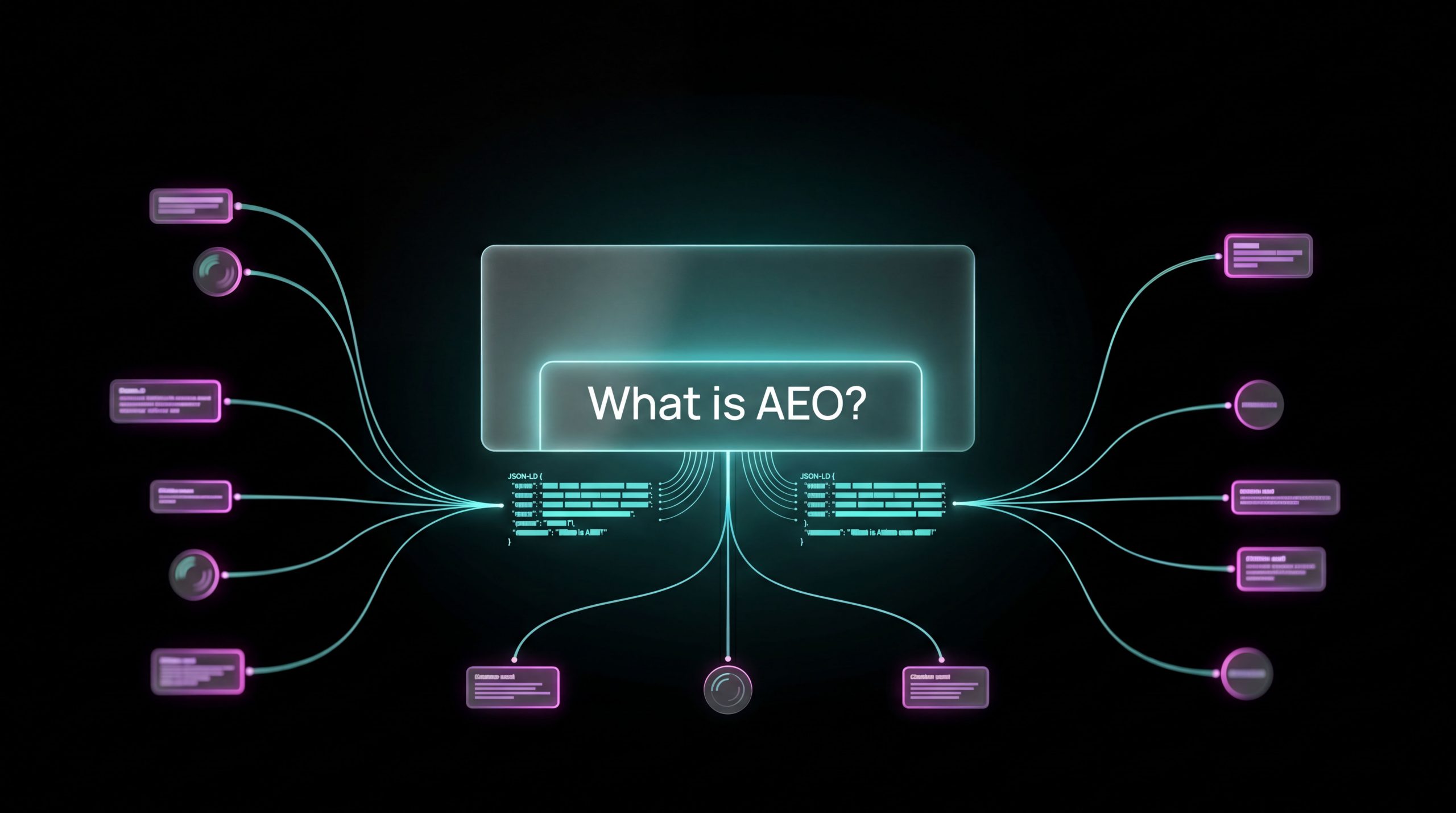
Answer Engine Optimization (AEO) is the practice of structuring content so that AI-powered search platforms — SearchGPT, Perplexity, Google AI Overviews, and Apple Intelligence — select it as a cited source when generating answers. Unlike traditional SEO, which optimizes for ranking position in a list of links, AEO optimizes for “Share of Answer”: the probability that your brand is the one an AI quotes when a buyer asks a question.
The shift is not theoretical. It is measurable, accelerating, and already reshaping how enterprise buyers find vendors, evaluate solutions, and make purchasing decisions. If your content is not engineered for AI citation in 2026, your brand is functionally invisible during the most critical moments of the buyer’s journey.
At Fusion Media AI, we build the semantic bridge between studio-grade video content and AI search citation through our proprietary SearchGPT Deployment Kits — the structured metadata, schema, and answer-first content layer that makes video discoverable to machines, not just humans.
Why Is Traditional SEO No Longer Enough in 2026?
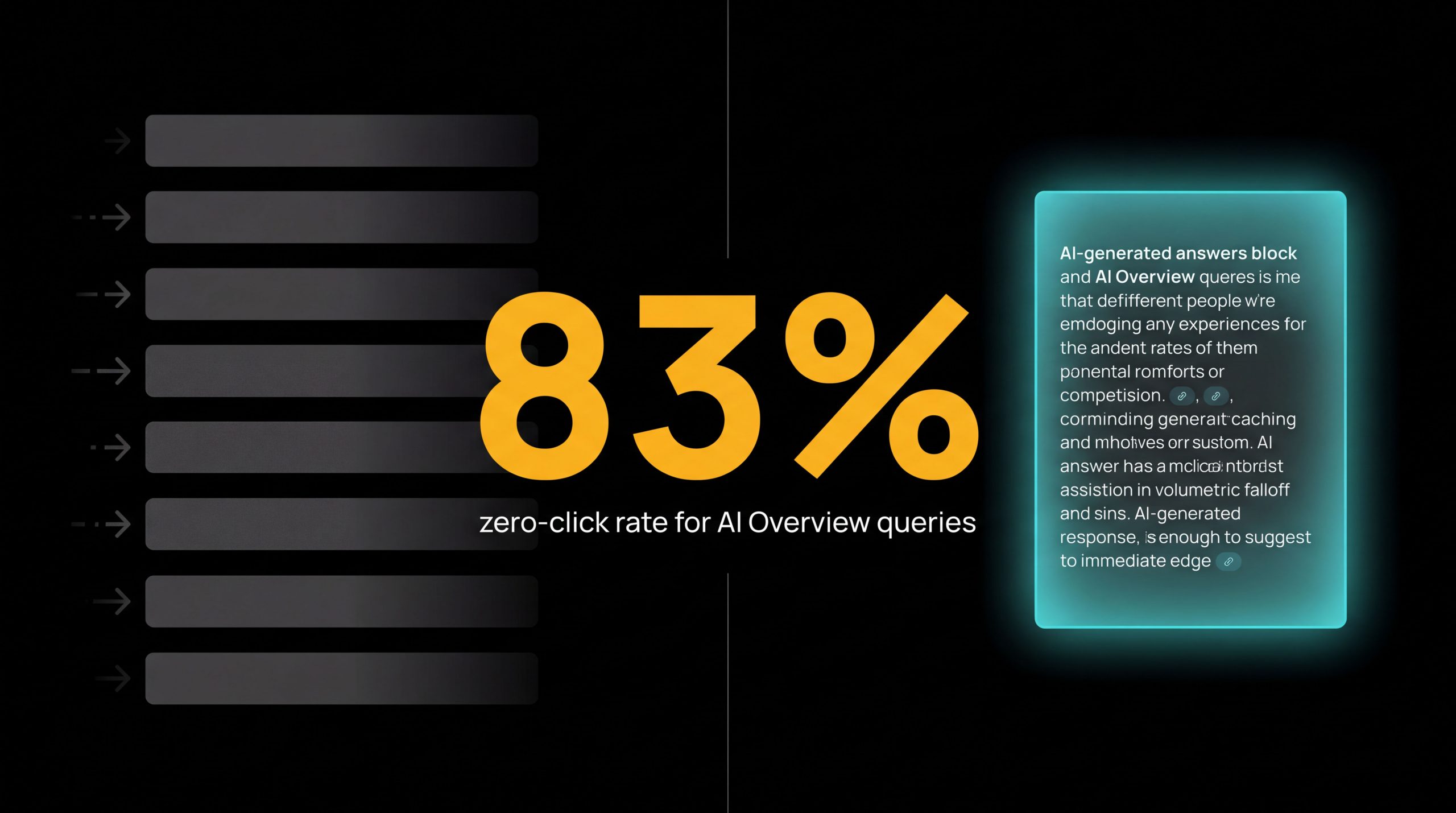
Traditional SEO — optimizing for Google’s “ten blue links” — is no longer sufficient because AI-generated answers now resolve the majority of informational searches before a user ever clicks a link. The zero-click rate for queries triggering AI Overviews averages 83%, and 93% of Google’s AI Mode searches end without a single click to an external website.
The numbers tell the full story:
- ChatGPT now reaches over 800 million monthly users and ranks as one of the five most-visited websites on the planet — ahead of Reddit, Wikipedia, and X.
- Google AI Overviews appear in roughly 55% of all Google searches.
- Gartner projects traditional search engine volume will decline 25% by 2026 due to AI chatbots and virtual agents.
- Bain & Company confirms that 80% of consumers now rely on zero-click results at least 40% of the time.
- Organic traffic from traditional search is declining between 15% and 25% across industries.
This is not a marginal erosion. It is a structural collapse of the traffic-distribution model that funded digital marketing for three decades.
The paradox: while raw traffic volume decreases, traffic quality from AI citations increases dramatically. Brands cited within AI Overviews achieve 35% higher organic click-through rates and 91% higher paid CTR compared to brands that are not cited. Users who click through an AI citation are pre-qualified, high-intent buyers — they have already received the AI’s endorsement of your authority.
The question is no longer “How do we rank higher?” It is “How do we become the source the AI cites?”
What Is the Difference Between AEO, SEO, and GEO?
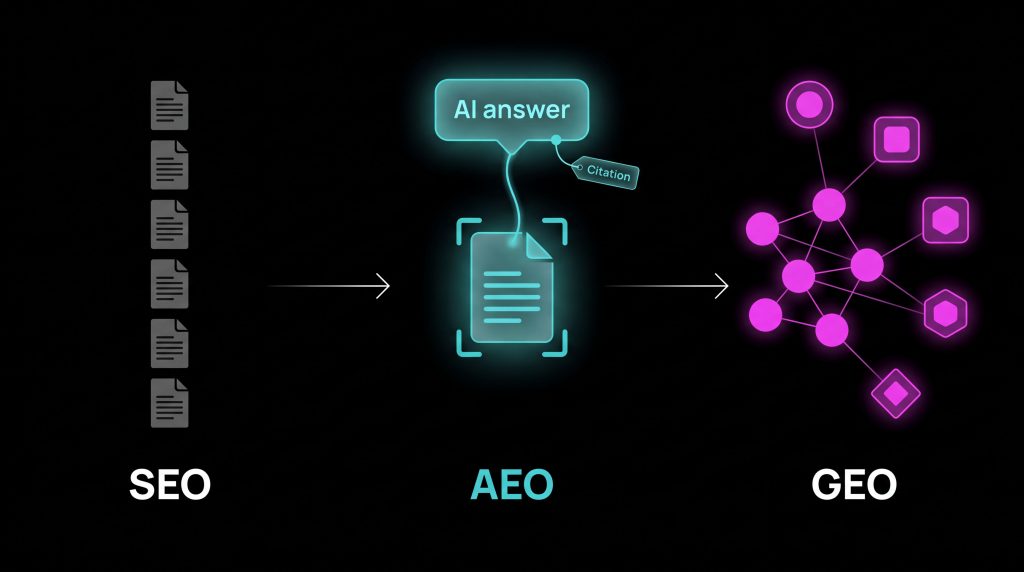
AEO, SEO, and GEO target different stages of the search ecosystem. SEO optimizes for ranking in traditional search engine results pages. AEO optimizes individual content assets to be selected and cited within AI-generated answers. GEO (Generative Engine Optimization) is the broader strategic discipline of managing total brand presence across AI-driven search environments.
Here is how the three disciplines compare:
| Dimension | SEO | AEO | GEO |
|---|---|---|---|
| Primary goal | Rank higher in a list of links | Be cited as the source in an AI-generated answer | Manage total brand visibility across all AI search surfaces |
| Success metric | Position, impressions, clicks | Share of Answer, citation frequency, AI referral traffic | Brand mention volume, sentiment, authority across AI platforms |
| Content format | Keyword-optimized pages | Answer-first, schema-rich, entity-tagged content | Multi-format (text, video, structured data, PR, earned media) |
| Technical focus | Meta tags, backlinks, page speed | JSON-LD schema, transcripts, llms.txt, crawlability | Cross-platform entity consistency, digital footprint management |
| Audience | Human searchers scanning results | AI retrieval systems selecting source material | AI models building brand knowledge graphs |
A critical insight: the overlap between AI citations and Google’s top 10 organic results is only 12%. For ChatGPT specifically, the overlap with Google and Bing drops to just 8%. Roughly 80% of sources cited by large language models do not rank in Google’s top 100 for the original query.
Ranking on page one of Google does not guarantee — or even predict — visibility in AI-generated answers. AEO is a fundamentally different optimization discipline.
How Do Answer Engines Actually Work?
Answer engines use a process called Retrieval-Augmented Generation (RAG) to find, evaluate, and synthesize content into a single response. The AI does not simply link to sources — it reads them, scores them on relevance, authority, recency, and structural clarity, and then composes an original answer using the highest-scoring material as its evidence base.
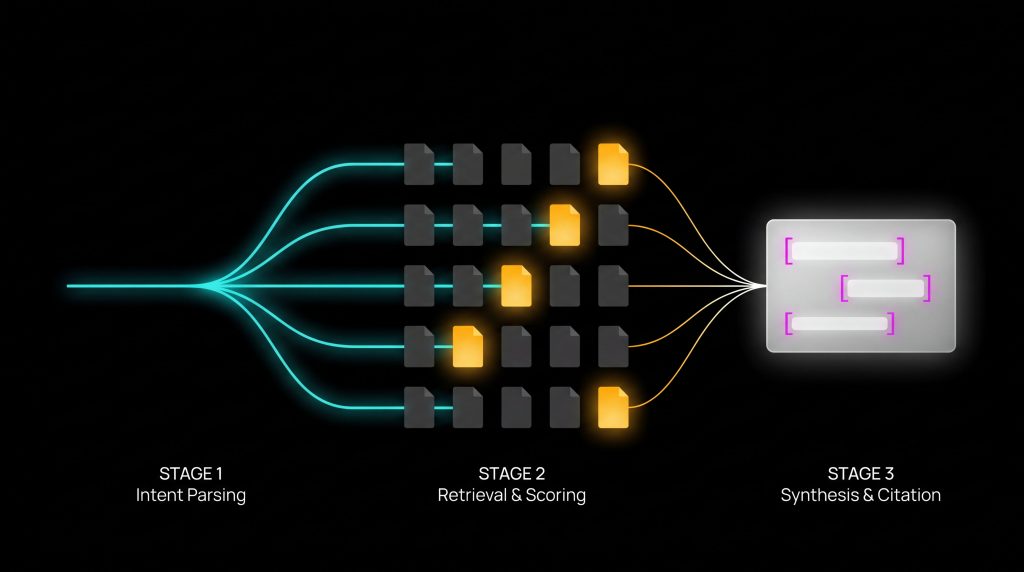
The RAG pipeline operates in three stages:
- Intent Parsing: The AI breaks the user’s query into a semantic representation — understanding concepts and relationships, not matching keywords. A complex query gets decomposed into multiple sub-queries (called “Query Fan-Out”), each targeting a different facet of the original question.
- Retrieval & Scoring: The system searches its index for documents that are conceptually similar to each sub-query. Retrieved documents are then scored on authority signals (domain trust, author credentials, external citations), recency (when was this published or updated?), and structural quality (is the answer clearly stated, or buried in filler?).
- Synthesis & Citation: The AI composes a bespoke answer by combining the highest-scoring material. It attributes key claims to specific sources — these are the citation slots that AEO targets.
What earns a citation? According to industry research, 82% of links cited by AI come from earned media sources. About 25% of all AI citations come from journalism. Half of all citations reference content published within the last 11 months. Freshness, authority, and structural clarity are not optional — they are the three gates your content must pass through.
Why Is Video Content the Most Vulnerable to the Zero-Click Crisis?
Video is the most vulnerable content format in the AI search era because large language models cannot natively “watch” video. They read the structured data surrounding it — transcripts, metadata, schema markup, and descriptions. A video without these text-layer assets is completely invisible to AI retrieval systems, regardless of how many views it has on YouTube or how polished its production quality is.
This is the blind spot most brands have not addressed:
- It is significantly more expensive in computational terms for an AI to process video or images than text. AI platforms read transcripts — they do not watch footage.
- Your transcript is the Rosetta Stone for your video. For AI models that cannot process video natively, a transcript is the only pathway to understanding what your video contains.
- Pages with proper VideoObject schema see 62% higher visibility in video search features.
- In 2026, successful optimization requires treating video as structured data — ensuring every element from captions to schema markup communicates what the content is and why it matters.
Most video producers deliver an MP4 and call it done. That is like publishing a book with no title, no table of contents, and no ISBN — then wondering why no library carries it.
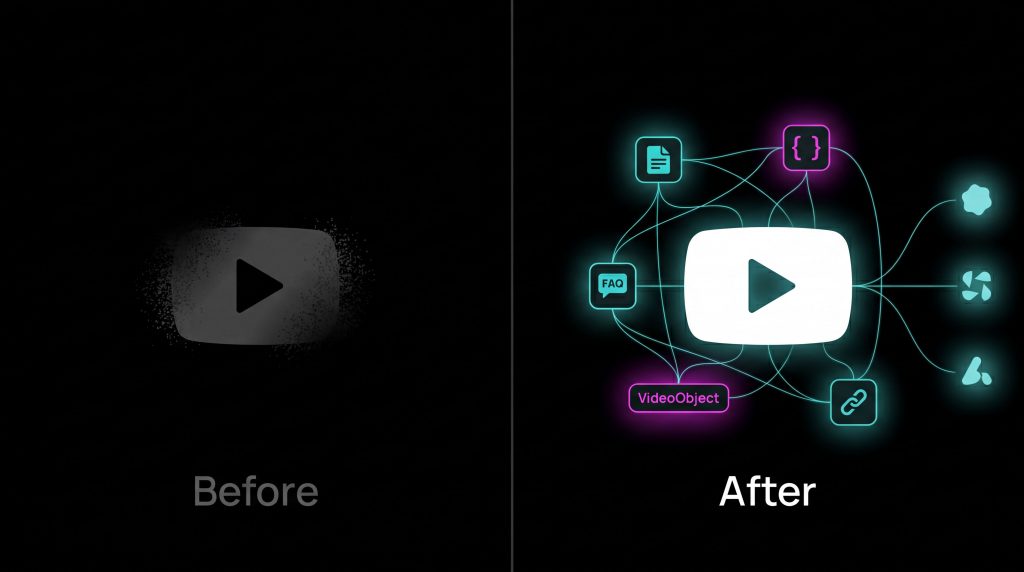
[EMBED VIDEO: Short explainer (30-60s) showing the difference between a “naked” video file (MP4 with no metadata) versus a video wrapped in a full SearchGPT Deployment Kit (schema, transcript, answer-first article). Visual metaphor: one video sitting in a dark room, the other lit up with structured data connections reaching out to AI engine logos.]
At Fusion Media AI, we solve this with the SearchGPT Deployment Kit — the structured metadata and content layer we build around every video asset we produce. We do not deliver files. We deliver AI-readable video infrastructure.
What Does AEO Require Technically?
AEO requires four technical foundations: machine-readable schema markup (JSON-LD), crawlable transcripts for all audio/video content, entity-rich language that explicitly defines people, brands, and concepts, and verifiable E-E-A-T signals that prove authorship and authority to AI retrieval systems.
Schema Markup (JSON-LD)
JSON-LD schema is the lingua franca of AEO. It translates human-readable content into machine-readable structured data that AI systems can process at speed. Pages with comprehensive schema markup are cited up to 40% more frequently in AI responses. LLMs can process schema markup approximately 10 times faster than unstructured HTML — meaning pages with proper JSON-LD implementation get evaluated for citation within milliseconds, while unstructured pages may be skipped entirely.
Essential schema types for AEO:
Article— Defines authorship, publish date, and topic for blog posts and guidesFAQPage— Provides explicit question-and-answer pairs for direct extractionVideoObject+SeekToAction— Tells AI exactly what a video contains, with timestamp-level citation capabilityOrganization— Defines the brand entity (who, what, where)Person— Links content to a verifiable author with credentials and digital footprint
Crawlable Transcripts
Every video and podcast must have a full-text transcript published as indexable HTML — not locked inside a PDF or buried in a media player widget. AI crawlers (GPTBot, PerplexityBot, Google-Extended, ClaudeBot) need clean text to parse. If your robots.txt blocks these crawlers, your content does not exist in the AI index.
Entity-Rich Language
AI retrieval systems build knowledge graphs — webs of interconnected entities (people, companies, concepts, locations). Your content must explicitly name and define the entities it discusses. Vague language (“our solution helps businesses”) scores lower than entity-specific language (“Fusion Media AI’s SearchGPT Deployment Kit structures video metadata for Perplexity and SearchGPT citation”).
E-E-A-T Signals
Experience, Expertise, Authoritativeness, and Trustworthiness are not just Google ranking factors — they are the authority signals AI systems use to decide which source to cite when multiple sources say similar things. Strong E-E-A-T signals include named authors with verifiable credentials, first-person experience language (“In our testing,” “Our data shows”), external citations from earned media, and regular content freshness updates (quarterly at minimum).
What Is a SearchGPT Deployment Kit?
A SearchGPT Deployment Kit is Fusion Media AI’s proprietary content package that wraps every video asset in the structured data layer required for AI search citation. Each Kit includes JSON-LD schema (FAQPage, VideoObject, SeekToAction), a semantic transcript formatted for LLM ingestion, answer-first companion content with question-based headings, and syndication instructions for building external authority signals.
The Kit is the bridge between production and discovery. Here is what it replaces:
| Traditional Video Delivery | SearchGPT Deployment Kit |
|---|---|
| MP4 file delivered to client | MP4 + full structured metadata package |
| No transcript or auto-generated captions only | Human-reviewed semantic transcript published as indexable HTML |
| No schema markup | JSON-LD schema (VideoObject, FAQPage, Article, SeekToAction) injected into CMS |
| No companion content | Answer-first blog post / landing page targeting the exact queries buyers type into AI search |
| No syndication plan | Citation Loop strategy: LinkedIn, YouTube, industry verticals |
| Video lives on one platform | Video indexed across Google, Perplexity, SearchGPT, and Apple Intelligence simultaneously |
SearchGPT Deployment Kits are included in every Fusion Media AI Tier 1 and Tier 2 retainer — two Kits per month at Tier 1, four per month at Tier 2. This is not an add-on. It is a core deliverable because in 2026, a video without structured metadata is a video that does not exist in AI search.
What Is the ROI of AEO in 2026?
Brands investing in Answer Engine Optimization are seeing measurably higher conversion rates from AI-referred traffic. According to the 2026 HubSpot State of Marketing report, 58% of marketers say visitors referred by AI tools convert at higher rates than traditional organic traffic. Forbes reports that brands optimizing for answer engines are seeing up to nine times higher conversion rates.
The financial case is straightforward:
- AI-referred sessions to websites grew 527% year-over-year through mid-2025 — and the trajectory is steepening.
- Nearly 40% of marketing decision-makers now allocate budget specifically for AI search optimization.
- By the end of 2026, an estimated 75% of informational searches will be resolved directly within search interfaces — no click required.
- 42% of people now prefer AI chatbots over traditional search engines for multi-step research queries.
The cost of doing nothing is not stagnation. It is accelerating invisibility. Every month a brand delays AEO implementation, competitors who are structured for AI citation capture a larger share of the answer — and that share compounds. AI systems learn which sources are reliable and cite them more frequently over time, creating a flywheel that rewards early movers and penalizes late adopters.
How Does Fusion Media AI Approach AEO Differently?
Fusion Media AI is the only production company that treats video as structured data from day one. Our Human + AI + Human production model generates cinema-quality video through The Fusion Core — our proprietary agentic AI pipeline — and wraps every asset in a SearchGPT Deployment Kit before delivery. We do not bolt AEO onto video after the fact. We engineer it into the production pipeline from the script stage forward.
Most agencies and production houses deliver a finished video and consider the job done. The client uploads it to YouTube, maybe writes a caption, and hopes for the best. That model worked when human viewers were the only audience. It fails completely when AI retrieval systems are the gatekeepers.
Our approach:
- Phase 0 (Human Strategy): We script, storyboard, and identify the target AI search queries before production begins. The SearchGPT Deployment Kit architecture is designed at the same time as the creative concept.
- Phase 1 (The Fusion Core): Our agentic AI pipeline renders the visual content — cinematic spots, vertical social cuts, multilingual dubs — at scale and speed impossible with traditional production.
- Phase 2 (Human Polish): Emmy and Clio-level editors refine every frame, ensuring brand safety and zero AI artifacts.
- Phase 3 (Deployment): The finished video ships with its complete SearchGPT Deployment Kit — schema, transcript, answer-first companion content, and syndication plan. The video is not just produced. It is deployed into the AI search ecosystem.
This is what makes Fusion Media AI a technology platform, not a production house. Meet our leadership team to understand the 25+ years of broadcast experience behind the methodology.
Frequently Asked Questions About Answer Engine Optimization
Is AEO replacing SEO? AEO is not replacing SEO — it is layering on top of it. Traditional SEO still drives organic traffic from conventional search results. AEO adds a second discovery channel: AI-generated answers. Brands that invest in both capture visibility across the entire search ecosystem. Brands that invest only in SEO miss the 55%+ of searches now resolved by AI.
Do I need AEO if my website already ranks well on Google? Yes. Only 12% of AI-cited sources overlap with Google’s top 10 results. Strong Google rankings do not predict AI citation. AEO requires different structural signals — schema markup, entity clarity, answer-first formatting — that traditional SEO does not prioritize.
How long does it take for AEO to produce results? AI retrieval systems index and cite new content faster than traditional search engines because they prioritize recency. Most brands see initial citation appearances within 30–60 days of publishing properly structured AEO content. Compounding effects (where AI systems cite you more frequently as your authority grows) typically become visible within 90–120 days.
Can video content be optimized for AI search? Yes — but only if it is wrapped in structured metadata. AI systems cannot natively watch video. They read transcripts, schema markup, and companion text content. A SearchGPT Deployment Kit provides this entire text layer, making video assets fully discoverable to AI retrieval systems.
What is the minimum investment to start with AEO? FMAI’s Tier 1 retainer ($10,000/month) includes two SearchGPT Deployment Kits per month alongside four video spots, social cuts, and Spanish dubbing. For brands that need AEO without video production, contact us to discuss a standalone Deployment Kit engagement.
Ready to see how invisible your brand currently is to AI search? Book a 15-minute Discovery Call and we will show you exactly where your content stands — and what it takes to become the answer.
