Industry
OpenAI's Fake Cinema Camera Revealed a Real Truth About the Future of AI Video Production
An April Fools' concept camera from OpenAI accidentally mapped the future of AI video. Here's what "Engine Cinema" reveals about where production is really heading.
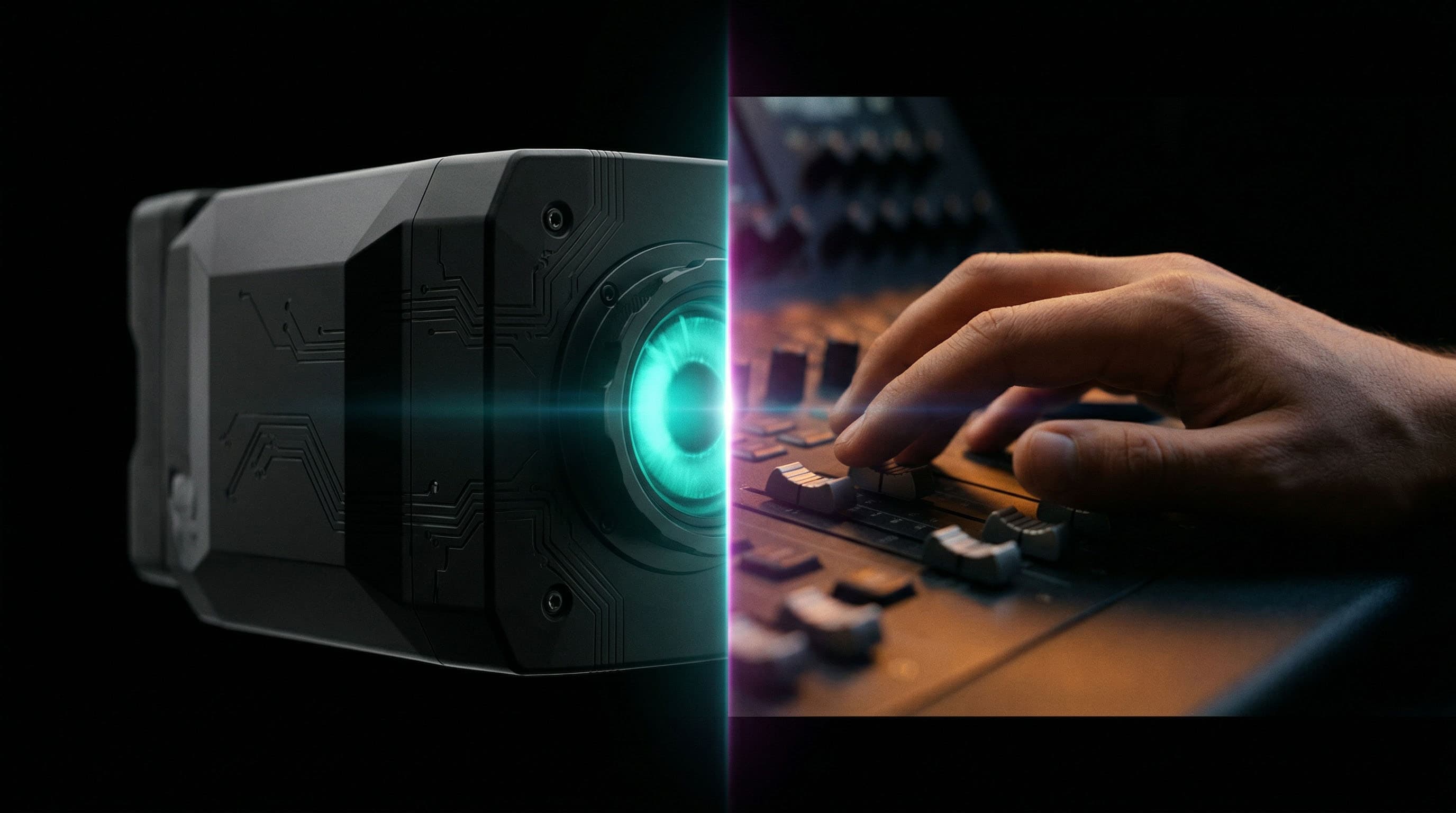
On April 1, 2026, Y.M.Cinema Magazine published a detailed spec sheet for "Engine Cinema," a fictional OpenAI cinema camera that captures AI-native data instead of traditional video files. It was an April Fools' joke. But buried inside the prank was a blueprint that accidentally mapped where AI video production is actually heading.
What Was OpenAI's "Engine Cinema" Camera?
Engine Cinema was a fictional cinema camera concept published as an April Fools' piece. The article described a hardware imaging system featuring a square 36mm × 36mm sensor, 10K resolution, prompt-assisted cinematography, and a proprietary format called "Latent RAW" where footage is stored as interpretable scene data rather than fixed video files.
The concept was presented as the strategic successor to Sora. According to the fictional keynote narrative, OpenAI concluded that generating synthetic reality was less effective than capturing real-world data in a format AI models could natively interpret.
The article was convincing enough to fool cinematographers, production professionals, and industry commentators before readers noticed the publish date. But here's what matters: the reason it fooled people is because the underlying logic isn't fiction. Every major trend in AI video production is converging toward exactly this kind of hybrid system.

Why Did a Fake Camera Feel So Real to the Production Industry?
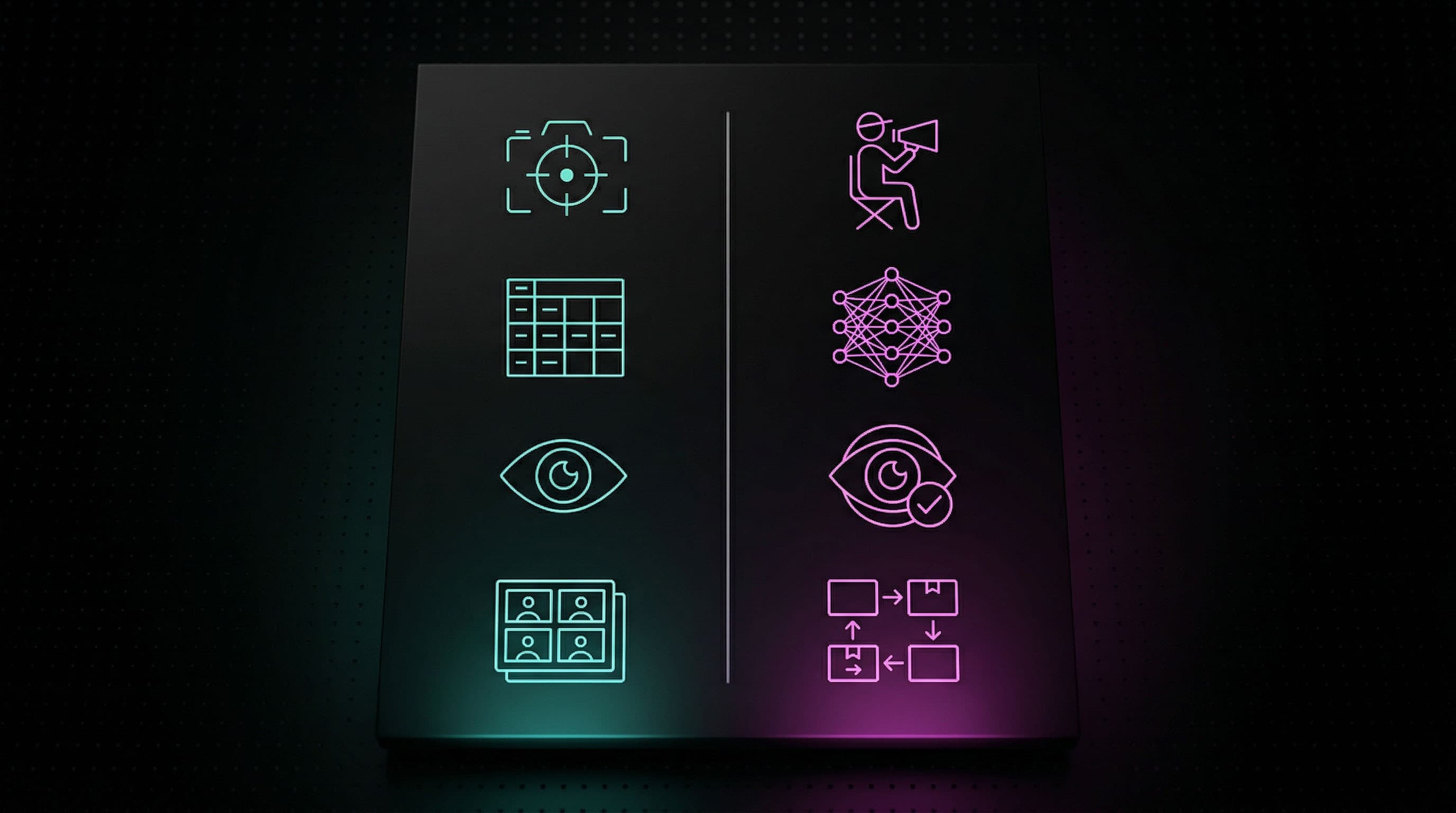
The Engine Cinema concept resonated because it addressed a tension the entire production industry already feels: the gap between what generative AI promises and what it actually delivers on set. Engine Cinema proposed a middle path: capture reality, then let AI interpret it.
- Physics remain inconsistent. AI-generated footage frequently fails on reflections, fluid dynamics, gravity, and multi-object interactions.
- Temporal coherence degrades under complexity. A 5-second synthetic clip can look stunning; a 60-second narrative sequence exposes the seams.
- The "uncanny valley" persists. Human subjects in AI-generated video still trigger subconscious rejection in viewers, particularly in close-ups and dialogue.
These aren't obscure technical problems. They're the exact barriers every AI video production company encounters daily. This is precisely why our Human + AI + Human production model exists. We don't hand a prompt to a model and ship what comes back. We script and direct with human creative judgment, generate at scale through The Fusion Core, and then polish every frame with Emmy and Clio-level editorial craft. That is also why the camera was never the edge; operator judgment is the durable advantage.
What Would an AI-Native Camera Actually Mean for Video Production?
An AI-native camera, one that captures scene data as interpretable representations rather than fixed pixel arrays, would collapse the boundary between production and post-production. Exposure, color temperature, depth of field, and even lighting could become adjustable parameters after the shoot.
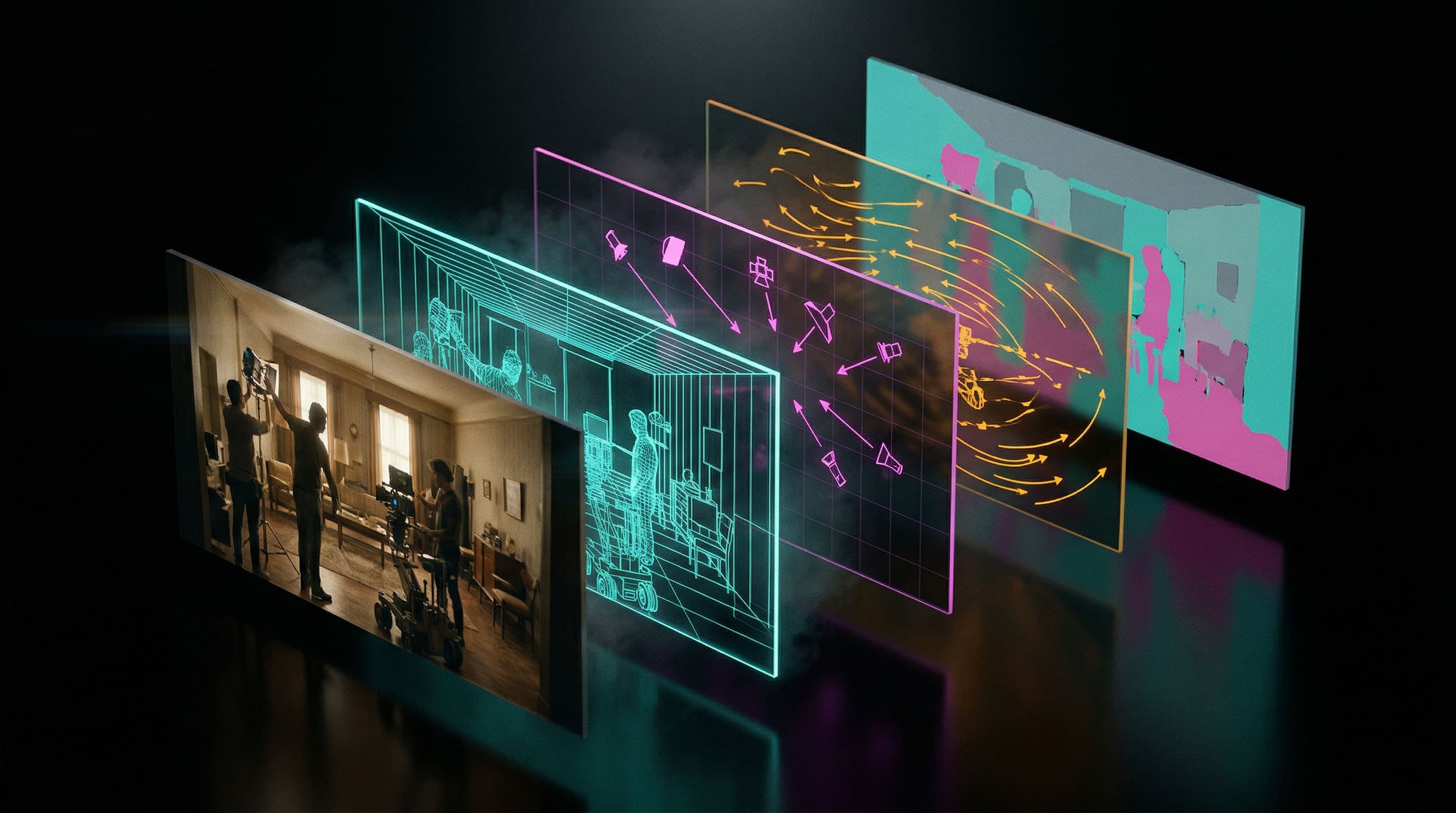
While the specific implementation is fictional, the concept maps directly to real trends:
- Computational photography (already standard in smartphones) adjusts exposure, HDR, and noise in real time using on-device ML inference.
- Neural Radiance Fields (NeRFs) and 3D Gaussian Splatting already reconstruct full 3D scenes from 2D captures.
- Light field cameras (Lytro's abandoned technology) attempted exactly this kind of "decide focus later" capture a decade ago.
The Data Flywheel: Why an AI Company Would Want to Build a Camera
A camera built by a foundation model company isn't just a capture device. It's a training data pipeline. Every frame recorded through an AI-native sensor would feed structured, high-fidelity scene data back to the model maker in exactly the format their video generation models need to improve.

Current video models train primarily on YouTube, Vimeo, and publicly scraped web footage: compressed, inconsistently lit, unpredictable in quality. The bottleneck for next-generation video models isn't compute or architecture. It's high-quality, structured, physically grounded training data.
For production companies like ours, this reinforces a principle we operate by: own your creative pipeline, understand who benefits from the data that flows through it, and ensure your clients' intellectual property is protected at every stage.
How Does This Connect to the Human + AI + Human Production Model?
The Engine Cinema concept, even as fiction, validates the production architecture that forward-looking AI video companies already use. The future isn't fully generative and it isn't fully traditional. It's a hybrid where human creative direction bookends AI-powered generation: exactly the Human + AI + Human model.

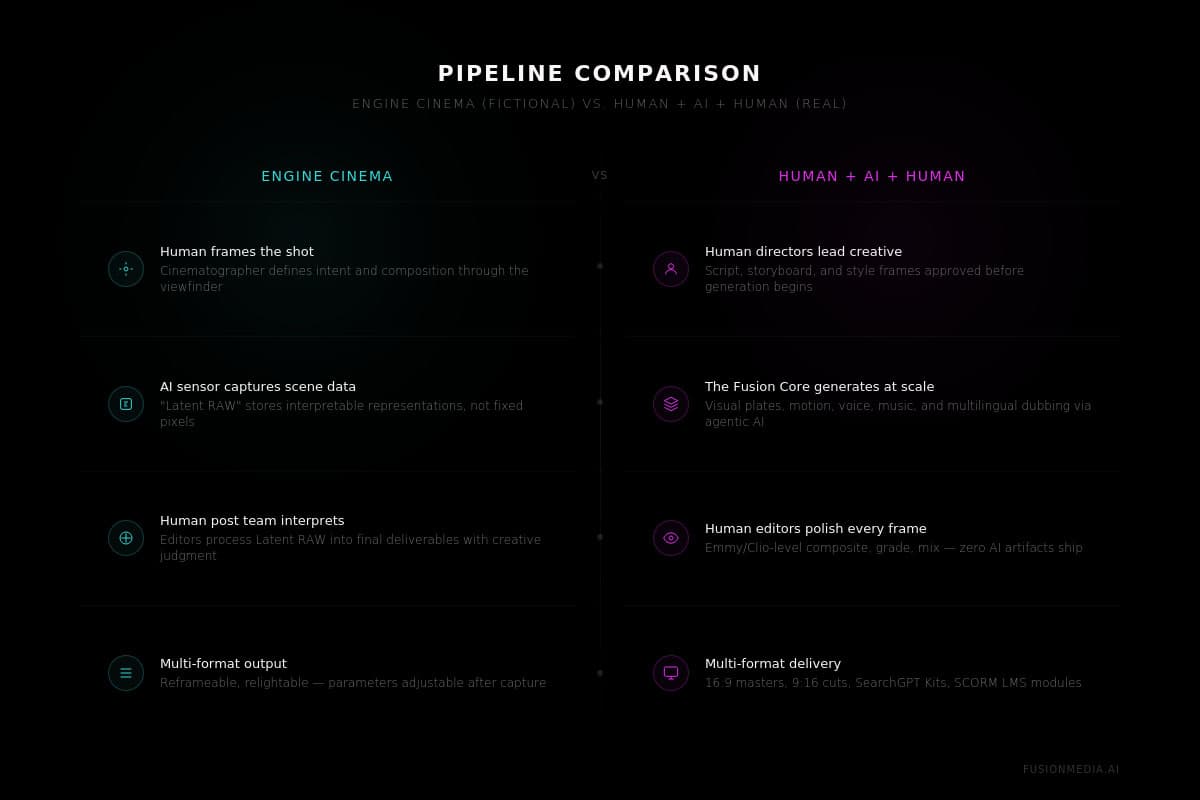
| Engine Cinema (Fictional) | Human + AI + Human (Real) |
|---|---|
| Human cinematographer frames the shot and defines intent | Human directors script, storyboard, and approve creative direction before generation begins |
| AI sensor layer captures interpretable scene data | The Fusion Core generates visual plates, motion, voice synthesis, music, and multilingual dubbing at scale |
| Human post team interprets Latent RAW into final deliverable | Emmy/Clio-level editors composite, color grade, mix audio, and remove all AI artifacts |
| Output is multi-format (reframeable, relightable) | Output is multi-format (16:9 masters, 9:16 social cuts, SearchGPT Deployment Kits, SCORM-wrapped LMS modules) |
What Should CMOs and Production Leaders Take Away from This?
The Engine Cinema thought experiment reveals three truths every brand investing in video production should internalize.
- Fully synthetic video is not replacing production crews anytime soon. The pivot away from pure generation felt credible. That tells you where professional sentiment actually sits.
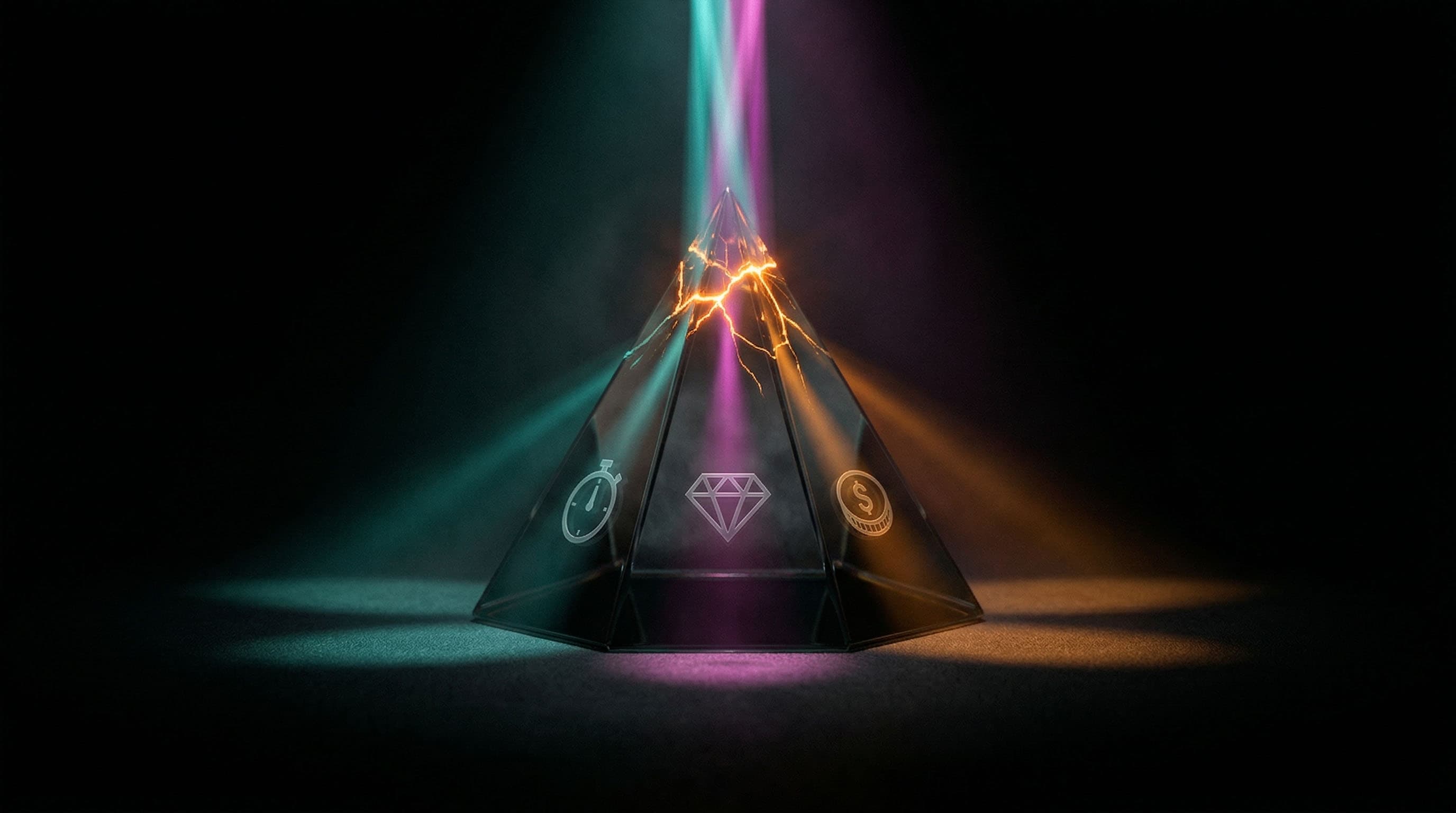
- The companies that thrive will be the ones operating at the intersection. AI breaks the production triangle (Fast, Cheap, Good: pick two) and delivers all three.
- Data provenance and IP protection matter more than ever. Every brand producing AI-assisted video content should ask: where does my footage go? Who trains on it? Is my data isolated?