Deskless / Franchise · Services program
Franchise Training Binders Cost You $1.17M/Year: Here's Why
The binder is not the line item. The turnover it causes is. For a mid-sized 50-location operator, the binder drives a $1.17M annual replacement-cost bill: 50 locations × 25 crew × 130% turnover × $3,500 per hire. Here is the math, and the AI microlearning model replacing it.
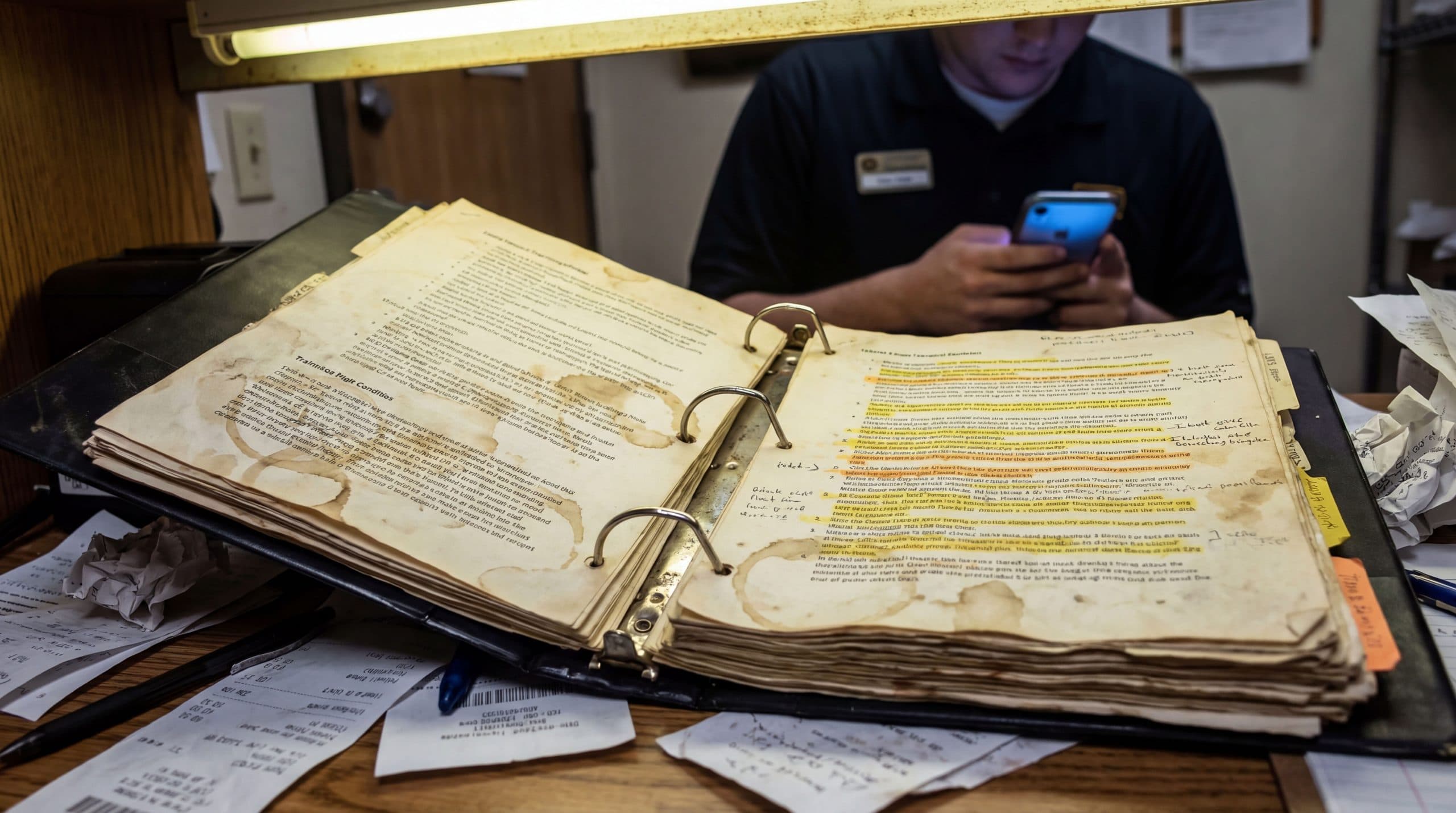
Every franchise and multi-unit operator in America still ships a 3-ring training binder to every new hire. For a mid-sized 50-location operator with 25 crew per location and the industry-standard 130% deskless turnover rate, that binder is driving a $1.17 million annual replacement-cost bill. The math is simple: 50 × 25 × 130% × $3,500 per replacement = $1,137,500. The print bill is rounding error. The expensive thing the binder is doing is making people quit.
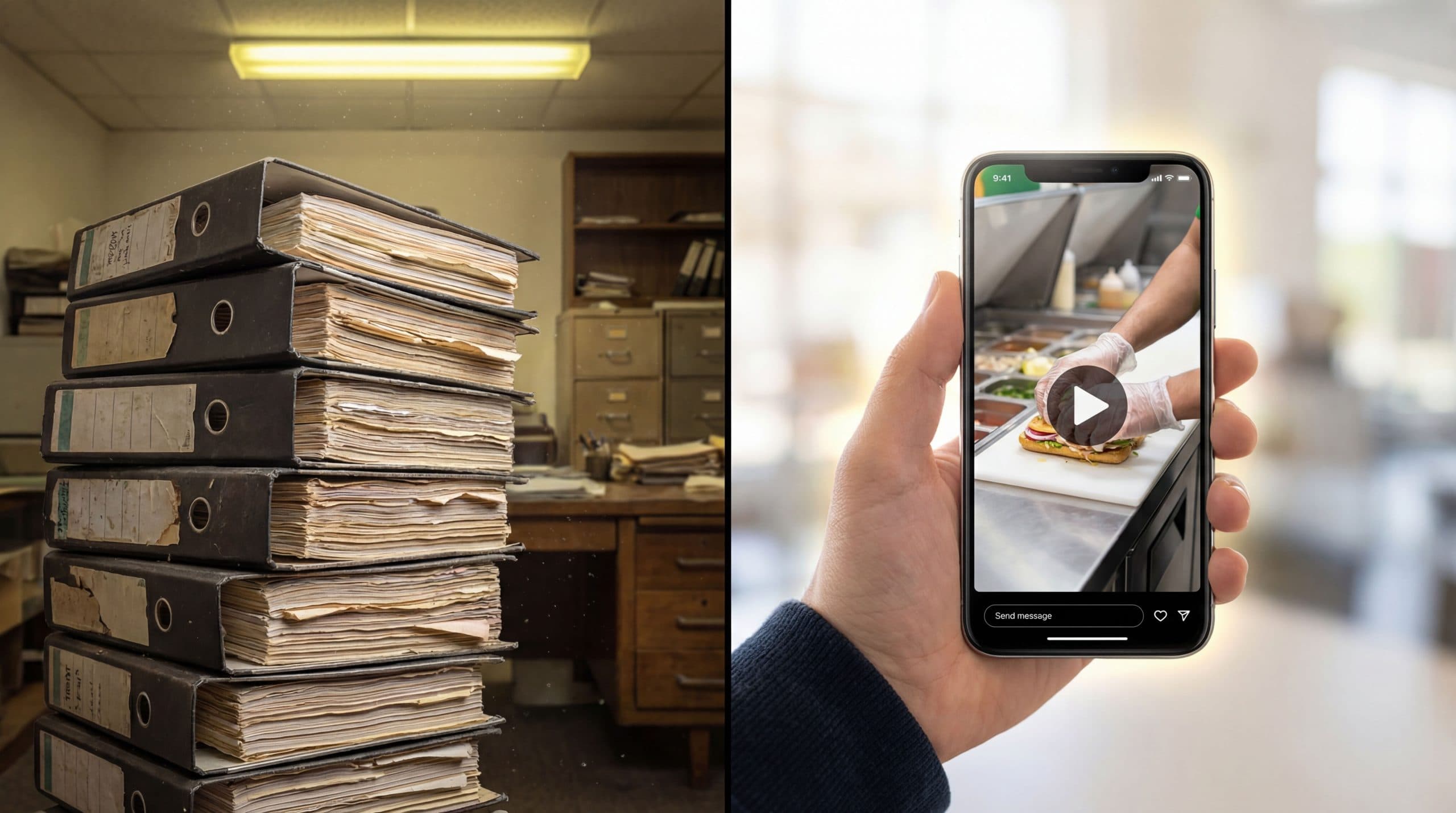
If you run a multi-unit operation (QSR, fast casual, retail, fitness, hospitality, automotive), your binder is not a training problem. It is a retention problem dressed up as a training problem. And the line item is not Print Procurement. It is Replacement Cost.
The Actual Math: 50 × 25 × 130% × $3,500 = $1.17M
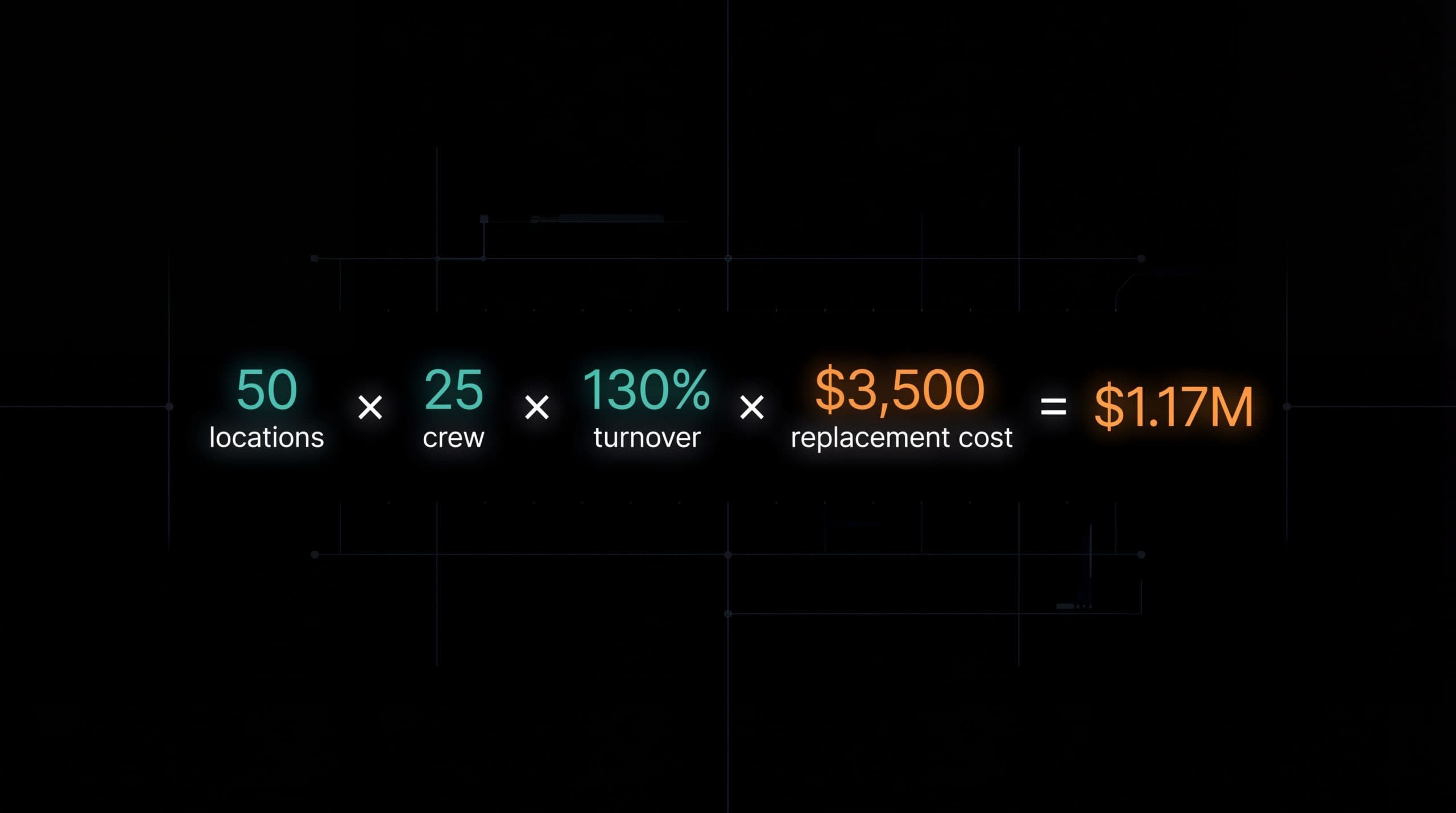
Replacement cost (the all-in cost of recruiting, onboarding, and ramping a single deskless worker to productivity) sits at roughly $3,500 in 2026 across QSR, retail, and hospitality. Multiply by your active crew and your turnover rate and the binder’s real cost shows up immediately.
- 50 locations is a typical mid-sized franchisee or regional operator footprint.
- 25 crew per location is standard for QSR and fast casual.
- 130% turnover is the industry-published deskless rate: not the worst case, the average.
- $3,500 per replacement covers recruiting, paperwork, manager onboarding hours, lost productivity during ramp, and the customer-experience cost of a green crew member on the line.
Scale the same equation:
| Footprint | Crew | Turnover | Replacement Cost | Annual Bill |
|---|---|---|---|---|
| 10 locations | 25 | 130% | $3,500 | $113,750 |
| 50 locations | 25 | 130% | $3,500 | $1,137,500 |
| 100 locations | 25 | 130% | $3,500 | $2,275,000 |
| 500 locations | 25 | 130% | $3,500 | $11,375,000 |
| 1,000 locations | 25 | 130% | $3,500 | $22,750,000 |
None of this shows up on the P&L as a single line. It hides inside Operations, HR, Recruiting, and Manager Time: four buckets that rarely sit in the same room long enough to add the numbers up. So the home office keeps printing binders, because the binder cost is visible and the turnover cost is not.
Why Does the Binder Drive Turnover?
A binder loses a new hire in the first 72 hours. Deskless workers in 2026 are mobile-native, often training in their second or third language, and judging your brand against every other employer in their pocket on day one. A 200-page binder full of stained pages, highlighter scrawl, and 2019 regulations does not say "we invested in you." It says "good luck." The new hire decides whether to stay or quit before they have ever finished the binder, and most quit.
- Cognitive load. A binder forces the learner to convert dense text into a mental simulation of the task. Video shows the task. Retention research consistently puts well-structured video at 65–95% versus 10–20% for text alone.
- Language access. A meaningful share of the deskless workforce trains in a non-English first language. The binder is English-only or has one bad Spanish translation glued in the back. Native-language video is table stakes for retention now.
- Mobile-first reality. Crew studies on a phone, in fragments, between rushes. 60–90 second video chunks match the way they actually learn. A 200-page binder does not.
- Manager Time Tax. The binder requires the manager to walk every new hire through it. That pulls the manager off the floor for 6–10 hours per hire. Bad for the manager, bad for the customer, bad for the new hire, who is being trained by a manager who would rather be anywhere else.
When training feels like a cost the company is unwilling to invest in, employees price that into their decision to stay. They leave faster. You replace them faster. The replacement-cost flywheel speeds up.
What Replaces the Binder? AI Microlearning, SCORM-Wrapped, Multilingual.
The binder is being replaced by a library of 60–90 second AI-generated microlearning modules: scripted in the brand voice, dubbed into every language the workforce speaks, delivered to the frontline phone via QR code or LMS, updated in 24 hours when a menu or regulation changes, and tracked through SCORM completion data that satisfies modern compliance standards. The unit cost of producing a module has collapsed. The unit speed of updating one has collapsed even further.
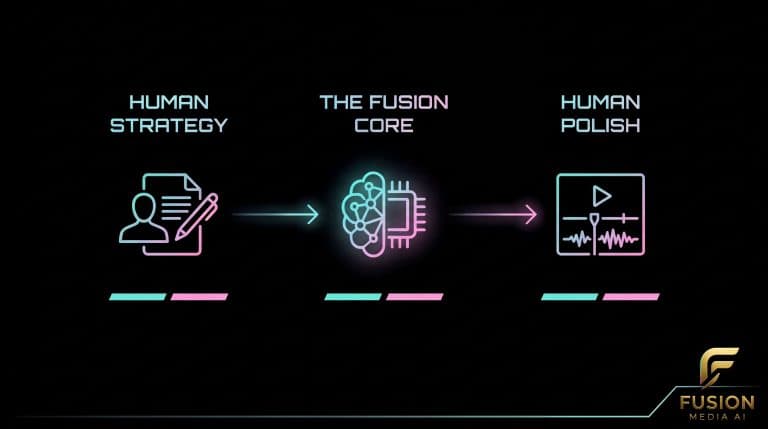
At Fusion Media AI we produce franchise microlearning libraries through our Human + AI + Human pipeline. Human instructional designers script and structure each module. The Fusion Core renders visuals, voice, and multilingual dubs at scale. Human editors with broadcast pedigree polish every module before it ships. The output is SCORM-wrapped for any major LMS, vertical-format for phone, and version-controlled so a single module update propagates system-wide in under 24 hours.
What the model replaces, line by line:
| Binder | AI Microlearning Library |
|---|---|
| Printed and shipped | Delivered to phone via QR or LMS: zero print, zero ship |
| Static the day it lands | Updated in 24 hours when a regulation or menu changes |
| English-only or one bad translation | Dubbed into every language the workforce speaks (60+ supported) |
| Two-week new-hire ramp | 3–5 day new-hire ramp (~4× absorption rate of print) |
| Manager-led, 8 hours per hire | Self-paced on phone, manager validates and signs off in minutes |
| Sign-in sheet for completion | SCORM completion data, time-on-task, quiz score, audit-ready |
| Field trainer travels to patch gaps | Module re-renders at the home office, deploys to all units |
| Compliance drift is invisible | Every regulatory update triggers a versioned module refresh |
What the Math Looks Like After the Migration
The reason this migration is the easiest CFO conversation in the operations stack is that the savings come from the same line item the binder was hiding inside: replacement cost. Cut turnover from 130% to 90% by giving new hires a training experience that signals investment, and the same 50-location operator goes from $1,137,500 in annual replacement cost to $787,500. That is $350,000 saved per year, before you count the recovered manager hours, the compliance reduction, or the ramp-time gain.
- Turnover cut from 130% to 90% on a 50 × 25 footprint: ~$350K/year recovered.
- Manager Time Tax recovered: 6–10 hours × hires-per-location × fully-loaded manager rate, typically $10K–$14K per location per year, or $500K–$700K system-wide at 50 locations.
- Field-trainer travel eliminated: $50K–$150K per year for a 50-location operator.
- Compliance exposure reduced: a single avoided wage-and-hour or harassment claim ($40K–$250K) typically pays for the entire library build.
A complete AI microlearning library for a 50-location operator (40–60 modules, multilingual, SCORM-wrapped, with a Living Content Retainer for ongoing updates) is scoped and quoted to your footprint. Payback is generally under six months once turnover and Manager Time Tax are counted honestly.
Corey HoltgardFounder & Creative Director, Fusion Media AI